
On August 8, 2025, the media Público published a news item that has ignited the debate inside and outside the Spanish Socialist Workers Party (PSOE): the federal commission of ethics and guarantees has issued a resolution prohibiting its elected and organic officials from adding the Q+ to the acronym LGTBI when they speak on behalf of the party.
A decision that, although it may seem like just a matter of letters, raises much deeper questions: what does it mean to leave out queerness? Who decides which identities deserve visibility?
What Q means and why it matters
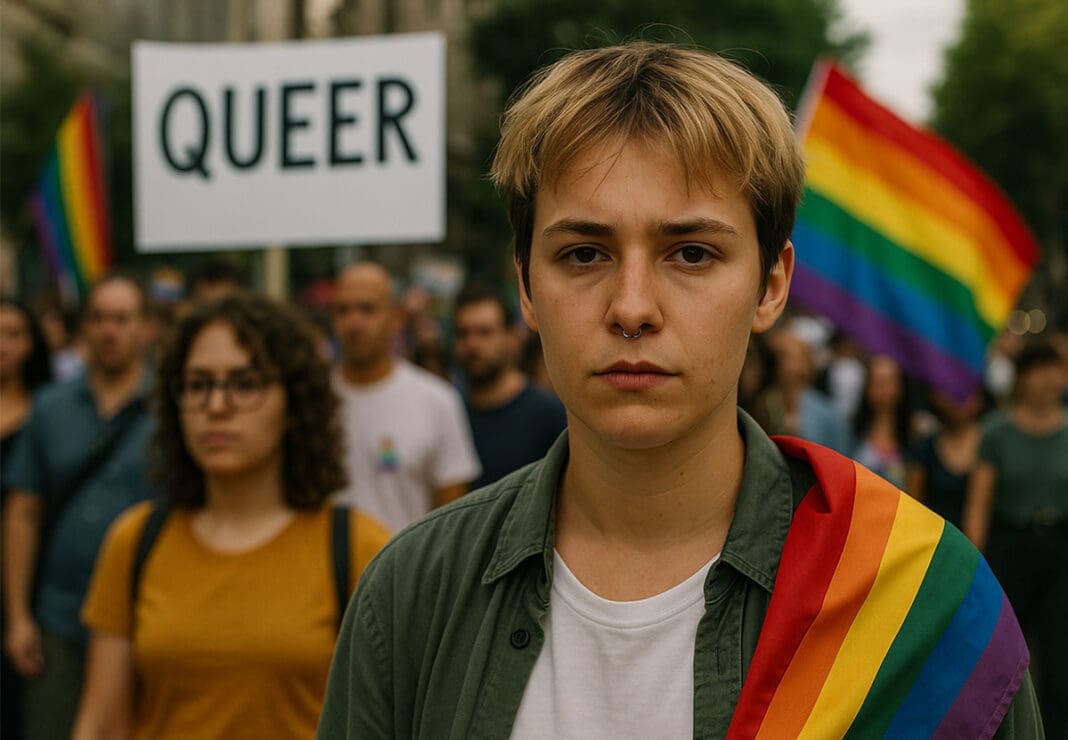
Within the umbrella of the acronym LGTBIQ+, the Q represents what queer, a term that was originally an insult in English (“strange”, “strange”), but one that activism proudly recovered to redefine it. Today, queer encompasses non-normative identities and expressions of gender and sexuality that do not feel comfortable within closed labels.
In other words, queer is not a disaster box: it is a space of resistance, a place where people who transit, question or break established categories fit. Here come those who do not identify with binary genders, who live their orientation fluidly, or who understand that their identity does not need to be validated by traditional labels.
Removing the Q from institutional discourse is not only symbolically painful, it also has real consequences: if it is not named, it does not exist. And if it does not exist, it becomes invisible.
Invisibility is not innocent
In politics, words matter. Acronyms matter. And the absences, even more.
The PSOE decision comes in a context in which the recognition of queer people continues to be an open front: from laws that do not contemplate non-binary realities, to speeches that reduce diversity to a “love whoever you want” that leaves out issues of gender, expression and identity.
For the LGTBIQ+ community, this decision sounds like a step backwards. Not because a political party is the guarantor of our identities—we ourselves defend that—but because institutionalism has a speaker that influences the collective imagination. If that speaker decides not to pronounce queer, it sends a message: “this is not relevant.”
The queer umbrella: broader than you think
Under the term queer we find a plurality that is not always understood. It is a concept that embraces ambiguity, that celebrates fluidity and that rejects that everything must have a rigid definition.
Some examples of people who may identify as queer:
- Those who feel comfortable with the lack of definition of their gender or sexuality.
- Those who combine elements of different identities and expressions.
- Those who do not fit into labels such as gay, lesbian, bisexual or trans, but are part of sexual and gender diversity.
- Those who live their identity in a changing way over time.
Queer is not a fashion or a recent invention: it is a political and vital response to systems that seek to pigeonhole people into fixed categories.
A letter that bothers some
Why is the Q so uncomfortable? In part, because it challenges the idea that everything must be defined, classified and validated by an authority. Queer speaks of radical self-determination, and that does not fit well with certain political discourses that prefer “orderly” and “understandable” diversity for the general public.

In addition, the Q remembers that the group is not homogeneous, that not everything is rainbows, equal marriage and photos on networks. There are also people on the margins, and those people have the right to be visible.
Critical perspectives and open questions
It is true that, from an internal perspective, a party can decide to unify its communication to avoid “confusion” or “non-consensual messages.” It is also true that the acronym LGTBI is more widespread and socially recognized than LGTBIQ+. But here the question is: should communicative comfort come before visibility?
And a more uncomfortable question: what other identities could be left out tomorrow with the same argument?
The symbolic weight of the decision
It’s not just about partisan politics. The Q is a demand that has cost decades of struggle and pride. Erasing it from an institutional discourse is erasing the memory of activists, artists, thinkers and anonymous people who have made the term a refuge for those who do not fit into any other label.
History shows that what is not named is not protected. And at a time when anti-diversity discourses are growing in different countries, giving up symbolic ground can open the door to more serious setbacks.
A letter that is worth more than its typographical weight
The Q is not a fad or a whim. It is a reminder that the fight for LGTBIQ+ rights is also a fight against the labels that imprison us. Removing it is, for many, an attempt to fit diversity into comfortable molds for those in power.
Perhaps the question we should ask ourselves is: if the Q is uncomfortable, isn’t it precisely because it is necessary?