

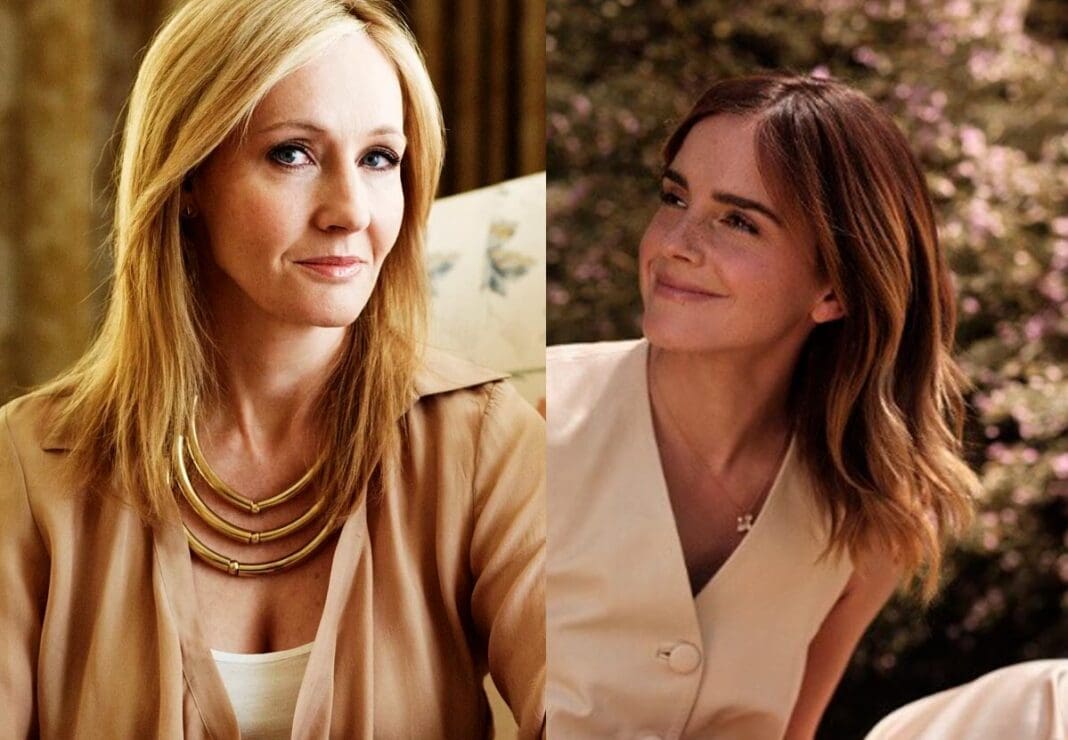
The recent controversy between acclaimed author J.K. Rowling and actress Emma Watson has lit up the networks and the media, highlighting the complexities of differences of opinion, especially on issues as sensitive as gender identity. What began as an expression of appreciation from Watson, despite the disagreements, has escalated into public criticism from Rowling, who calls the actress “ignorant” due to her privileged life experience.
The Origin of Friction: Ignorance or Different Realities?
J.K. Rowling, known for her outspokenness and controversial views on trans people, has returned to the spotlight. This time, her target has been Emma Watson, whom the author of the Harry Potter saga accuses of not understanding the reality of many women and girls due to her early fortune and fame. The writer argues that Watson’s experience, having been a “billionaire at the age of 14”, prevents her from understanding the implications of what Rowling perceives as a “destruction of women’s rights” in which, according to her, Watson has enthusiastically participated by supporting the LGTBIQ+ community.
Rowling, for her part, has shared details of her own life, marked by poverty before achieving success with her works. This experience, she says, gives her a unique perspective on the difficulties faced by women without privileges, and from there she criticizes Watson’s position.
Emma Watson: Between Appreciation and Disagreement
Rowling’s reaction comes following statements by Emma Watson on Jay Shetty’s mental health podcast. In this space, the actress expressed her wish that “people who do not share my opinions can continue to love me, and I wish the same towards those who think differently.”. Watson emphasized her ability to “value what we experienced together without agreeing with her opinions,” referring to her relationship with Rowling.
However, the author does not seem to share this vision of coexistence of ideas. In her tweet, Rowling admitted that Watson and other co-stars of the Harry Potter films “have every right to embrace gender identity ideology,” but did not hesitate to censure their attitude. The writer regrets that Watson and Daniel Radcliffe, in particular, have used their former professional partnership to criticize her opinions in public.
I’m seeing quite a bit of comment about this, so I want to make a couple of points.
I’m not owed eternal agreement from any actor who once played a character I created. The idea is as ludicrous as me checking with the boss I had when I was twenty-one for what opinions I should… https://t.co/c0pz19P7jc
— J.K. Rowling (@jk_rowling) September 29, 2025
The Burden of Fame and the Protection of the Protagonists
Rowling also revealed that, for a long time, she felt the need to protect the young actors in her films, whom she met as children. This feeling, however, seems to have dissipated. The author criticized Watson for sending her a note with a brief “I am very sorry for what you are going through” at a time of “media lynching”, when threats of death, rape and torture against her were at their peak. Rowling interpreted this gesture as a show of superficial compassion, in a context where, according to her, Watson had publicly contributed to fueling the fire.
What does this controversy tell us about dialogue in the public sphere today? Is it possible to maintain appreciation for a person while deeply disagreeing with their ideas, especially on issues of human rights and diversity? How do individual privileges and life experiences influence the formation of our opinions and the way we relate to others?
The discussion between J.K. Rowling and Emma Watson goes beyond a simple disagreement between two public figures. It invites us to reflect on empathy, understanding different realities and respect in an increasingly polarized world, where the voices of the LGTBIQ+ community struggle to be heard and respected.