
Pedro Zerolo Square prepares to remember the activist who marked a generation. Next June 8, Madrid dresses in memory, pride and commitment.
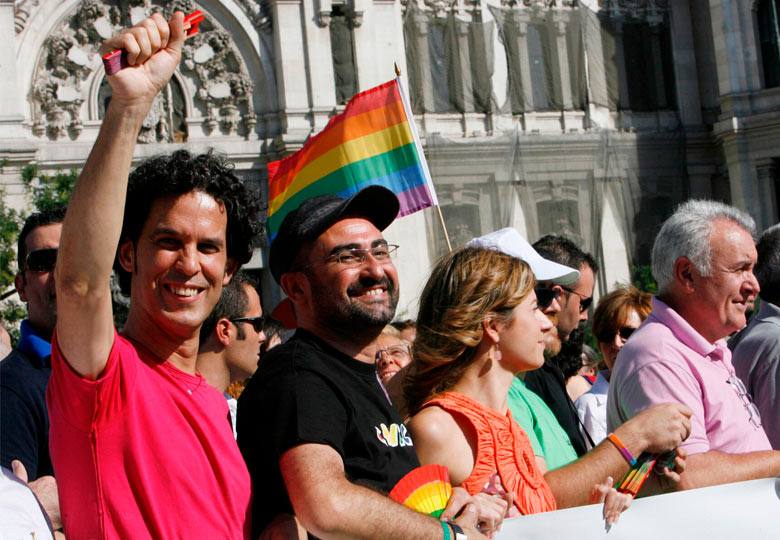
This 2025 marks ten years since Pedro Zerolo left us. Ten years without his voice, but with his legacy beating in every fight for equality. The PSOE of Madrid City has announced a commemorative event that will take place next Sunday, June 8, in the square that bears its name, in the Chueca neighborhood. It will be a moment to remember, reflect and, above all, continue walking.
Pedro Zerolo left us 10 years ago, but his fight and his voice are still present in our city.
This June 8, we are waiting for you in Plaza Pedro Zerolo to pay tribute to him with pride, with memory and with the socialist commitment that he always had. pic.twitter.com/hH8wWXVPSj
— PSOE in Ayto Madrid (@PSOEMadridAyto) June 2, 2025
The spokesperson and general secretary of the Madrid socialist group, Reyes Maroto, has made an appeal through social networks for citizens to attend the tribute. “We want to fill the Plaza de Pedro Zerolo with people from Madrid committed to rights and freedoms,” says Maroto in a video released this Monday.
The event aims to be a tribute to Pedro, activist, councilor and socialist activist who dedicated his life to defending the dignity of all people, especially the LGTBIQ+ group. His death, on June 9, 2015, left a void that is difficult to fill, but also a very clear message: there is no full democracy without diversity, without inclusion, without memory.
A political context that does not go unnoticed
The tribute coincides with the demonstration called by the leader of the Popular Party, Alberto Núñez Feijóo, also in Madrid, for the same day. Under the slogan “Mafia or democracy”, the PP calls for mobilization against the Government of Pedro Sánchez, in an attempt to capitalize on political discontent with a symbolic motion of censure.
From the PSOE, however, the choice of the date does not seem to have been coincidental. “Today, more than ever, we want to remember his legacy,” emphasizes Maroto, underlining that Zerolo represents an ethical and political commitment radically opposed to that promoted by those who use institutions as weapons of confrontation.
In that sense, this tribute is not only a look at the past, but also a position in the present. How can we honor Zerolo without defending today what he defended then? How to separate memory from activism?
An invitation to participation and reflection
Beyond the acronyms, the truth is that Zerolo was much more than a politician. He was a symbol, he was a reference and he was, above all, a person deeply committed to social justice. Therefore, filling Pedro Zerolo Square next Sunday will not just be a symbolic gesture. It will be a reaffirmation of shared values.
This tribute also challenges us on a personal level. What have we done in this decade to follow the example he left? What challenges remain pending for the LGTBIQ+ community and for our democracy?
We may not have all the answers, but remembering those who paved the way always helps us find new questions.
This June 8, we celebrate the tribute of @PSOEMadridAyto to Pedro Zerolo, 12 years councilor in @MADRID and a lifetime dedicated to freedom, equality, the defense of the public and social justice.
Their fight remains alive in every step we take.https://t.co/03vSXSlEvr
— Pedro Zerolo Foundation (@FPedroZerolo) May 31, 2025
Who was Pedro Zerolo and why is his legacy still so present?
Pedro Zerolo was much more than a politician. Born in Venezuela in 1960 and living in Spain from a very young age, he became one of the most visible and brave voices of LGTBIQ+ activism in our country. A lawyer by training and a socialist activist, he held different positions in the PSOE, including secretary of Social Movements and Relations with NGOs. He was also a councilor in the Madrid City Council and president of the State LGBT Federation (FELGTB).
But what really marked his career was his tireless defense of the rights of LGTBIQ+ people, at a time when raising one’s voice meant exposing oneself to insults, threats and exclusion. Zerolo not only spoke about equality: he fought for it from the streets and from the institutions.
His work was key to the approval of the Equal Marriage Law in 2005, a milestone that made Spain one of the first countries in the world to recognize the right to marriage between people of the same sex. That achievement was not the result of a political strategy, but rather of years of activism, social pressure and moral conviction. Zerolo was, without a doubt, one of the driving forces behind that historic change.
In addition, he knew how to build bridges between social movements and institutional politics, opening spaces so that many previously marginalized voices could participate in democratic construction. His figure combined commitment, sensitivity and a unique ability to generate consensus without giving up firmness.
Zerolo died in 2015 due to cancer, just a few weeks after taking office as a councilor in the Madrid City Council. He was 55 years old. His death left a deep mark on the LGTBIQ+ movement and throughout progressive civil society.
Today, a square in the heart of Chueca bears his name, and his memory remains alive in every fight for human rights, diversity and real equality.