

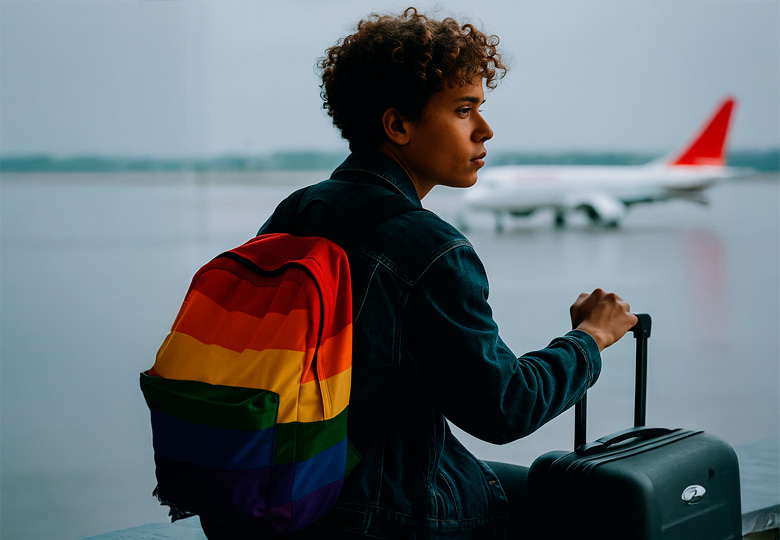
Sometimes migration has nothing to do with looking for work, studying or escaping from war.
Sometimes people emigrate simply because they want to love freely, dress without fear, exist without hiding.
This is called sexile: the forced migration of LGTBIQ+ people who flee contexts where their identity or desire is criminalized, punished or made invisible.

In this article we are going to talk about sexile on a global scale: what causes it, where exiled people go, how they feel, what they lose… and also what they rebuild.
🌍 What is sexile (and why does it still happen)?
Sexile is a form of exile, but with a specific motivation: the sexual orientation, gender identity or gender expression of the person.
It is a silent, painful and more common phenomenon than we think.
In more than 60 countries around the world, relations between people of the same sex are criminalized. In at least 11, they could lead to the death penalty. And in many more, although there are no explicit laws, social homophobia and transphobia translates into violence, abandonment, prison, corrective rape or murder.
In this context, many LGTBIQ+ people have no other option but to leave.
🔥 Where do they migrate from?
Although each story is unique, there are regions of the world where sexile is more frequent:
Sub-Saharan Africa
Countries like Nigeria, Uganda or Somalia punish homosexuality with prison sentences or even death. The rise of recent anti-homosexual laws has multiplied the number of LGTBIQ+ asylum seekers.
Middle East and North Africa
In places like Iran, Saudi Arabia, Yemen or Egypt, being gay, lesbian or trans is illegal and can be lethal.
Many people try to reach Europe or Canada with study or work visas or directly as refugees.

Latin America and the Caribbean
Although there is progress in countries like Argentina or Uruguay, in others like Honduras, El Salvador or Jamaica trans and homosexual people are murdered with total impunity.
Hate crime and exile go hand in hand.
Eastern Europe and Central Asia
In Russia, Chechnya or Georgia, state and social harassment of the LGTBIQ+ population has caused internal and external displacement.
🏳️🌈 Where do people go?
📍 Canada
It is one of the countries most open to granting asylum for LGTBIQ+ reasons. It has public policies and associations that accompany queer refugees from the first moment.
📍 Spain
Spain not only recognizes the right to asylum based on sexual orientation or gender identity, but many cities have specific reception networks.
Barcelona and Madrid are key destinations for queer sexile.
📍 Germany, Netherlands, France
They also receive many requests, although in some cases the process is long and full of bureaucratic obstacles.
📍 Argentina
Although it is not always visible, Argentina has become a destination for LGTBIQ+ migrants, especially from neighboring countries.
It has one of the most advanced legislations on trans rights in the world.
🧠 How does this phenomenon affect the countries of origin?
Sexile represents a leak of diversity, creativity and social transformation.
Each queer person who leaves is one less activism, one less reference, one broken community.
In addition, silence is reinforced: the more those who could challenge the norm leave, the more the idea that “that doesn’t exist here” is perpetuated.
And let us not forget that many times it is the countries that have most colonized bodies and desires that later become “safe” destinations. This also raises uncomfortable questions about privilege, visas and global inequalities.
💬 And what happens to the person who migrates?
Migrating because of who you are is not the same as migrating by choice. It has its lights, but also its shadows.
🌟 The positive:
- Freedom to explore your identity without fear.
- Access to queer communities and support networks.
- Possibility of building emotional or sexual bonds for the first time.
- Legal recognition of your gender or relationships.
🌑 The painful thing:
- Family and emotional breakdown.
- Deep loneliness in the early years.
- Long, cold and invasive immigration procedures.
- Constant doubts about whether “you deserve to be here.”
- Racism, classism or xenophobia in the receiving countries, even within the group itself.
Migrating does not solve everything. But sometimes, it is the only thing that allows you to move forward.
🤲 How can we accompany these processes?
If you live in a receiving country, these are concrete ways to accompany with empathy:
- Listen without infantilizing or romanticizing.
- Learn about asylum rights for LGTBIQ+ reasons.
- Support associations that work with queer migration.
- Check your own privileges: not all queer people have the same opportunities.
- Make space for migrant voices within LGTBIQ+ activism. Let them speak.
❗ Critical reflection: aren’t we idealizing “safe” countries?
Yes, there are places where the laws protect more.
But that doesn’t mean they are paradises.
In many of these countries, racism, transphobia or xenophobia are also present, even in institutions, police forces or LGTBIQ+ associations.
Sometimes, the migrant escapes the fire to land in a cold house.
And inclusion must be more than just a signed piece of paper or a flag on the door.
🧭 Conclusion: migrating because you are you is an act of courage (and mourning)
Sexile is, at the same time, a wound and a hope.
An escape that sometimes becomes rebirth. Others, in perpetual exile.
And although we would like to live in a world where no one had to leave for love, reality reminds us that that world does not yet exist.
So, while we continue building it, let’s not look away.
Whoever migrates for love, identity or desire also deserves refuge, citizenship and pride.