
Every June 27 is celebrated International Day of Deafblind People.
A date that not only remembers those who live without hearing or seeing clearly, but puts at the center the dignity, struggle and richness of a different way of perceiving the world.
It is no coincidence that this day commemorates the birth of Helen Keller (1880-1968), the deafblind woman who defied her time and became an activist, writer and global symbol of improvement and rights.
The red and white cane: symbol of deafblindness
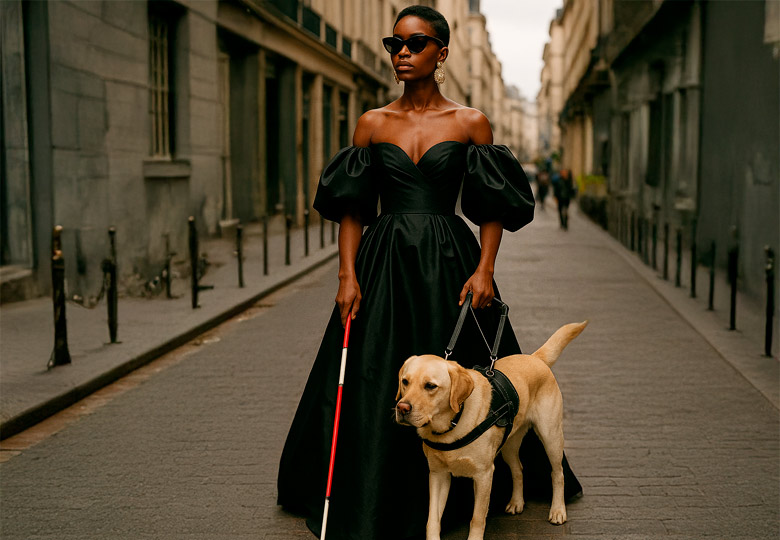
Perhaps you have seen it once and did not know its meaning: the white and red cane is the international badge of deafblind people. While the white cane indicates blindness and the red cane is associated with low vision in some contexts, the combination of both colors specifically identifies those who have visual and hearing disabilities. This cane not only serves as an orientation and safety tool, but also as a communication signal with the environment, so that drivers, pedestrians and professionals know that that person cannot receive auditory and visual information in a conventional way and needs adequate support.
What is deafblindness?
Although often confused with the sum of deafness and blindness, deafblindness is a unique disability.
It does not necessarily mean lacking 100% sight and hearing, but rather having a combination of visual and hearing deficiencies that seriously limit communication, mobility and access to information.
This translates into:
-
Need for tactile communication methods (palm fingerprinting, tactile sign language, braille).
-
Sometimes, requiring accompaniment to move around unfamiliar environments.
-
Living with less sensory stimuli, but with an inner world full of nuances, memory and haptic perception.
- Advertisement -
Helen Keller: beyond the myth
Many of us know his name, but few people know who he really was.
Helen Keller not only learned to communicate from her teacher Anne Sullivan, but she graduated from college, wrote books, and became a socialist feminist, pacifist, and radical disability rights advocate.
His figure inspires, but also invites reflection: how many deafblind people are today excluded from education, culture, work or social life simply because their access is not guaranteed?
What is it like to live as a deafblind person?
Each experience is unique, but there are common feelings:
- Social isolation due to communication barriers.
- Dependency on interpreters and guides in non-adapted contexts.
- Difficulty accessing basic or leisure information.
- Need for physical and tactile contact as the main channel of interaction.
- Great inner wealth, sensory memory and tactile orientation capacity.
What for a hearing-sighted person is a normal environment, for a deafblind person it can be a labyrinth without references.
And that, without adequate support, directly impacts mental and emotional health.
🏳️🌈 And the diversity within deafblindness?
Yes, it exists. And it is immense.
Not all deafblind people are born this way; some lose hearing and vision over the years.
Not all of them use the same communication method.
Not all of them have the same degree of visual or auditory rest.
And of course, within the deafblind community there are also LGTBIQ+, racialized, migrant, neurodivergent people or people with other associated disabilities.
But… are they being represented? Do their voices reach spaces of militancy and visibility?
Critical perspective: do we romanticize or ignore?
This is where it’s time to make people uncomfortable.
Many times, society falls into two extremes:
-
Romanticize: turn deafblind people into heroes of improvement, ignoring the lack of rights and support that they really need.
-
Ignore: assuming that their life is so different that we have nothing to learn or share.
Both extremes dehumanize. Because deafblind people are not just examples of struggle, they are citizens with the right to leisure, sex, mistakes, laughter and boredom like anyone else.
What does the deafblind community need?
Here are some essential demands:
✅ Legal and social recognition
In many countries, deafblindness is not recognized as a unique disability.
Without this status, the right to guide interpreters or specialized educators is not guaranteed.
✅ Access to information and culture
Subtitled, audio descriptions, materials in braille or adapted to tactile sign language.
Without accessibility, there is no participation.
✅ More support professionals
Guides-interpreters trained and sufficient to cover daily life, not just medical or legal procedures.
✅ Inclusive education
From childhood, guarantee schools and resources that allow academic, social and emotional development.
A life with meaning (literal and figurative)
Deafblindness is not a void of meaning.
It is another way of experiencing the world: through touch, vibration, spatial memory, smell, temperature, intuition.
It is a reminder that not everything important can be seen or heard.
That contact, skin, gestures and closeness also build communication and affection.
Conclusion: you do not have to “see” or “hear” to be recognized
The International Day of Deafblind People is not just for them.
It’s for all of us. To ask ourselves:
- What are we doing so they can participate in community life?
- What prejudices do we have about their capacity for autonomy, work or desire?
- What would we learn if we listened (with our hands, with our eyes, with our presence) to their vision of the world?
Perhaps the true social disability is our lack of empathy and creativity to include all forms of perception.