
An overview: Central America, between lights and shadows
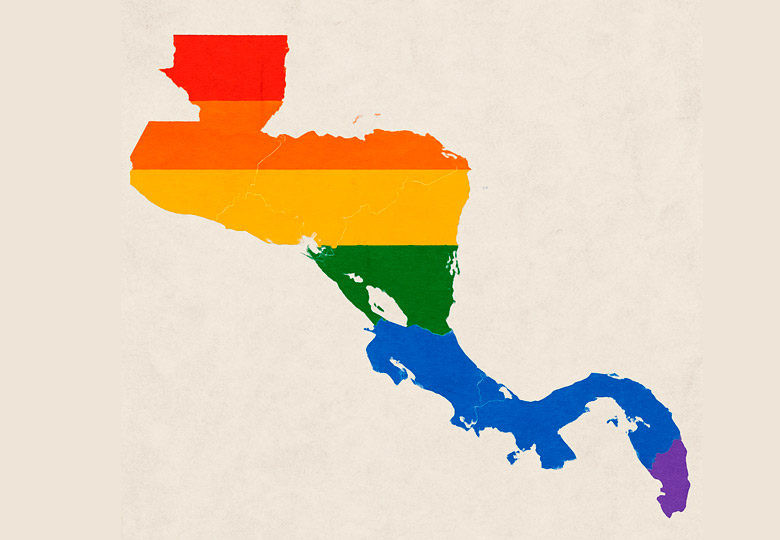
Central America is a vibrant region, rich in culture and diversity, but also plagued by historical inequalities, structural violence and deeply rooted religious conservatism. In this context, talking about LGTBIQ+ rights is not easy. As of July 2025, the outlook remains uneven, with some timid progress in certain countries and worrying setbacks in others.
Where are we today? The answer depends a lot on where you look. Guatemala, Honduras, El Salvador, Nicaragua, Costa Rica, Panama and Belize present very different realities. However, the constant is that the LGTBIQ+ community continues to face discrimination, stigma, violence and an alarming lack of legal protection in a large part of these territories.
Costa Rica and Panama: lights on the road
Costa Rica continues to be the country with the greatest progress in the region. Equal marriage has been legal since 2020, and although there are still challenges, public policies have been implemented that seek to include sexual and gender diversity. The Ministry of Health, for example, has developed inclusive protocols for trans people, and in education, awareness is promoted on issues of identity and orientation.
Panama has had a more irregular path, but in the last two years important steps have been taken. In 2024, the Supreme Court ruled in favor of recognizing certain property rights for same-sex couples, and in 2025 a bill to recognize civil unions is being debated. Although resistance remains strong, the public debate has begun to change.
Honduras, Guatemala and El Salvador: the weight of structural violence
In the so-called Northern Triangle of Central America, the situation is more critical. LGTBIQ+ people continue to be victims of systematic violence, both in the public and private spheres. Hate crimes are rarely properly investigated and impunity rates are chilling.
In Honduras, for example, trans activist Vicky Hernández was murdered in 2009 and her case only received justice 12 years later, thanks to a historic ruling by the Inter-American Court of Human Rights. However, little has changed since then: in the first half of 2025 alone, at least 11 LGTBIQ+ people have been murdered in the country, according to local organizations.
In Guatemala, although there is a vibrant network of activism, Congress continues to block any legislation that recognizes community rights. In 2025, a bill has been reactivated that aims to restrict the rights of trans people and prohibit “gender ideology” in schools, a measure that has generated strong rejection among human rights organizations.
El Salvador, for its part, has made some promises at a discursive level. The government has announced a national anti-discrimination strategy, but in practice it has not yet translated into effective public policies. The Salvadoran LGTBIQ+ community continues to demand legal recognition of gender identity, labor inclusion and real measures against violence.
Nicaragua: forced silence and repression
Talking about rights in Nicaragua in 2025 is complex. The government’s widespread repression has silenced a large part of civil society, including LGTBIQ+ activism. Organizations that previously worked openly have been forced to close or operate from exile.
The official discourse has almost completely erased any mention of sexual or gender diversity. Although there is no direct and systematic persecution against LGTBIQ+ people because of their identity, the climate of fear, censorship and social control seriously affects their right to organize, express themselves and demand justice.
Belize: discrete progress, persistent challenges
Belize decriminalized same-sex relationships in 2016, but progress since then has been slow. In 2025, possible legislation against discrimination based on sexual orientation is being discussed, but there are still no clear legal guarantees for trans people or equal access to health services, education or work.
The Belizean LGTBIQ+ movement, although small, is resilient and remains active in the fight for rights, especially at the community level. However, lack of political will and cultural prejudices remain serious obstacles.

And what about trans people?
In almost the entire region, trans people face the greatest barriers. The life expectancy of a trans woman in Central America does not exceed 35 years, a figure that says it all. The lack of access to legal documentation according to gender identity prevents many from accessing formal employment, health services or education without discrimination.
Only Costa Rica legally recognizes the change of name and sex on documents, and even then the process can be long and complicated. In the rest of the countries, institutional invisibility and daily violence continue to mark the lives of trans people.
Activism, hope and resistance
Despite this complex panorama, Central American LGTBIQ+ activism continues to be a source of hope. Collectives, shelters, organizations and networks have continued working, often without support from the State and facing personal risks.
Art, culture and alternative journalism have become powerful tools to denounce, make visible and propose. In cities like San Salvador, Guatemala City or Tegucigalpa, small marches, health fairs and safe spaces flourish even in adverse contexts.
A fairer future?
It is difficult to predict with certainty where the region is going. Will governments be able to listen to the demands of their LGTBIQ+ citizens? Will international pressure continue to guarantee human rights in Central America? Is it possible to imagine a region where loving freely is not a threat?
There is much left to do, but also many committed people along the way. The fight for LGTBIQ+ rights in Central America is not only legal or institutional. It is also a fight for dignity, for life and for the right to be who we are, without fear.
Critical perspective: is the rights discourse being co-opted?
Some analysts have pointed out that, in some countries, symbolic advances in LGTBIQ+ rights could be serving as smokescreens to cover up other forms of authoritarianism or repression. Inclusion on paper does not always translate into real improvement in people’s lives. Are we facing a policy of gestures or profound transformations? It is important not to lose sight of this tension.
The situation of LGTBIQ+ rights in Central America, as of July 2025, is complex and contradictory. There are reasons for hope, but also warning signs. The truth is that change will only be possible if those with political, economic and social power are truly committed to justice and equality. Meanwhile, the Central American LGTBIQ+ community continues to resist, create, take care of each other and demand a better future.