

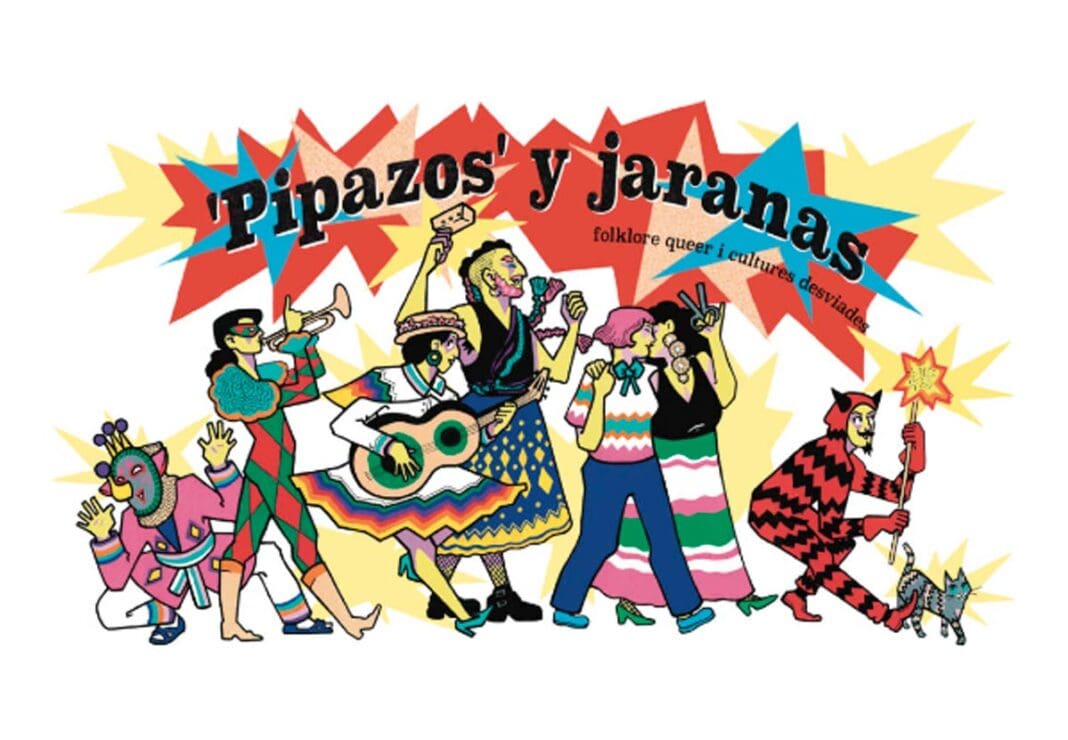
The LGTBI Center of Barcelona invites us on a fascinating and transgressive journey through its new programming cycle,“Pipazos y Jaranas. Queer folklore and deviant cultures.”A proposal that seeks to unearth and reinterpret folklore and popular culture from an LGTBIQ+ perspective, promising a space for meeting, celebration, criticism and reflection.
What is folklore in Barcelona today?
The cycle, which will run from November 2025 to January 2026, starts with a fundamental question that directly challenges us: what is the true folklore of Barcelona? Is it the demons, the correfocs, the big heads or the sardanas? Or perhaps cuplé, flamenco or rumba? And, crucially, what role do the migrant communities that have enriched the city’s cultural fabric for decades play?
These questions open the door to a deeper debate about the very nature of folklore. Who has the authority to define it? Is it an intrinsically racist, colonial or classist concept, or can we reappropriate it? Is he considered “high culture” or remains excluded from it? And the most provocative of all: is folklore inherently queer, or is it something we can “queerize”?
Throughout these three months, the program will seek to unravel these questions through a series of diverse and stimulating activities. You can consult the complete program here.
From Theory to Party: A Meeting in the Neighborhood
“Pipazos y Jaranas” is structured around a dialogue between theory and practice, reflection and celebration. Round tables have been organized that will explore the folklore of various communities, ranging from Catalan-rooted culture to “weird Spain”, passing through carnival and the cultural expressions of Andean communities in the diaspora, without forgetting the appropriations and oppressions suffered by the Andalusian gypsy people.
These reflections will be complemented by the presentation of the book “Rebels of Desire”, which narrates the biographies of artists who challenged gender and sexuality norms. In addition, other titles will be offered for consultation and loan at the Armand de Fluvià Documentation Center at Casal Lambda, located in the same LGTBI Center.
But the cycle does not remain just in theory. Practice and community are fundamental pillars. The exhibition “Danzar la fuga” will immerse us in dissident cultural expressions of the Andes, showing how the festival, carnival and dance become acts of insurgency, where the queer and the Andean converge in a common heritage of struggle and resistance.
Innovative workshops have been designed, such as a laboratory to research transvestites, copla, varietés and popular culture, seeking to reconstruct dissident memories through memories, photographs and oral stories. Another workshop invites you to reinterpret popular songs, such as corrandas or garrotins, to create a “queer songbook” that will come to life in an ephemeral choir.
The cycle also vindicates the memory of the peripheries with a guided route through the history of emotional, sexual and gender dissidence in Nou Barris. And as a culmination, the LGTBI Center will add a queer note to the Sant Antoni Festival in January, reaffirming its presence and the community spirit in the neighborhood that has welcomed them since 2019.
A Title with History and Mischief
The name of the cycle, “Pipazos y Jaranas”, is a wink loaded with meaning. “Pipazos” evokes the role of folkloric women in the defense of sexual and gender diversity, making reference to the famous phrase attributed to Lola Flores: “Who hasn’t ever had a pipazo with a friend?” For its part, “jarana” transports us to the festive atmosphere of the street, to the debauchery and the encounter around popular music and dance.
The design and illustrations, the work of Quino Coloma da Silva, reflect this carnival spirit, diverse and colorful, encapsulating the richness of what we can call queer folklore.
Are you ready to question the established and celebrate the diversity of our cultures? “Pipazos y Jaranas” awaits you