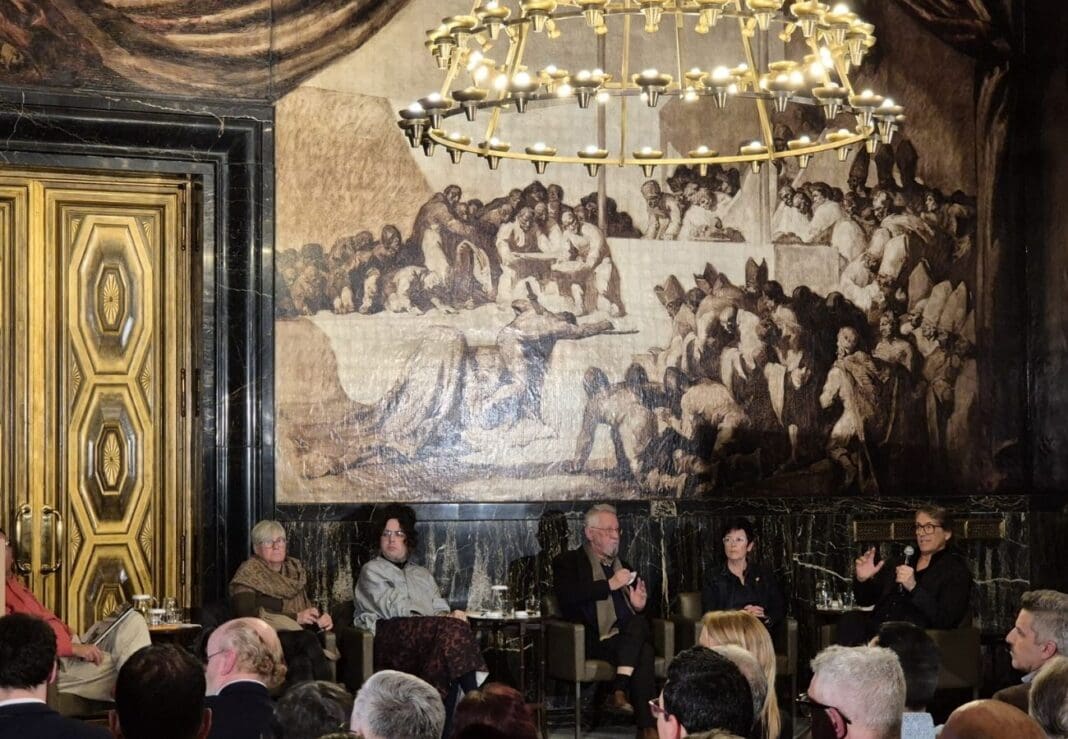


Yolanda Díaz signs with CCOO and UGT a framework of labor support that places trans people at the center of the process
The new protocol for trans people in the company signed by the Ministry of Labor and union organizations establishes guarantees of support, confidentiality and respect during labor transition processes.
The Ministry of Labor and Social Economy has signed a new accompaniment protocol for trans people in the business environment, an agreement promoted by the second vice president of the Government, Yolanda Díaz, together with union representatives from CCOO and UGT. The document establishes specific guarantees to protect the dignity, privacy and autonomy of trans people in their work environment.
The signing took place at the event “Neither invisible, nor vulnerable: Trans rights at work”, where the president of the LGTBI+ State Federation, Paula Iglesias, also participated.
The Ministry presented the agreement as a structural step to consolidate rights in the world of work. But what really changes in companies from now on?
A protocol within the framework of Law 4/2023
The signing coincides with the second anniversary of Law 4/2023 for the real and effective equality of trans people and the guarantee of the rights of LGTBIQ+ people. Specifically, article 15.1 already established the obligation to implement planned measures to ensure real equality in the workplace.
This protocol acts as a practical development of that obligation.
During the event, Yolanda Díaz stressed that the agreement goes beyond a technical document: “it is the country we want,” she stated, alluding to the need to protect rights in an international context where LGTBIQ+ people are once again in the political spotlight.
What the protocol establishes
The text is based on a reality confirmed by various studies: trans people are one of the groups that suffer the greatest discrimination in employment, both in access, permanence and promotion.
Faced with this, the protocol establishes a series of basic principles that companies and union representation must assume:
- Recognize and respect the gender expressed by the worker.
- Guarantee the use of chosen pronouns, even if there is no registry modification.
- Promote inclusive language that is respectful of diversity.
- Prohibit any retaliation or humiliating treatment.
In addition, it is specifically activated in cases of harassment or violence.
Confidentiality and decision-making power
One of the central elements of the agreement is that the trans worker will have the decision-making power throughout the entire transition process in the work environment.
The procedure will be confidential and reserved, with explicit guarantees to protect privacy.

Support may be initiated through voluntary communication to the reference person designated by the company. A joint commission may also be established with legal representation of the workers, incorporating, if possible, profiles specialized in trans diversity.
Concrete support measures
The protocol contemplates actions before, during and after the transition process, including:
- Contractual or documentary adaptations.
- Paid leave for medical care or administrative procedures.
- Professional support measures and career monitoring.
- Periodic meetings to evaluate the employment situation.
The company must guarantee agility in implementation and establish control and monitoring mechanisms.
Structural change or declaration of intent?
The approval of the protocol represents a clear framework for action, but its effectiveness will depend on the actual implementation in companies.
In Spain, trans people continue to face higher than average unemployment rates, job insecurity and difficulties in accessing certain sectors.
The question that remains open is obvious:
Will this protocol be a turning point in business culture or will it remain just another formal document?
Work and diversity: a democratic issue
The labor dimension of LGTBIQ+ rights is key. Employment is not only an economic support: it is a space for social recognition.
Ensuring that a person can transition without fear of losing their job or suffering reprisals is not a symbolic gesture. It is a question of democratic dignity.
Because real equality is not limited to the civil registry. It is also played in the day-to-day life of the company.