
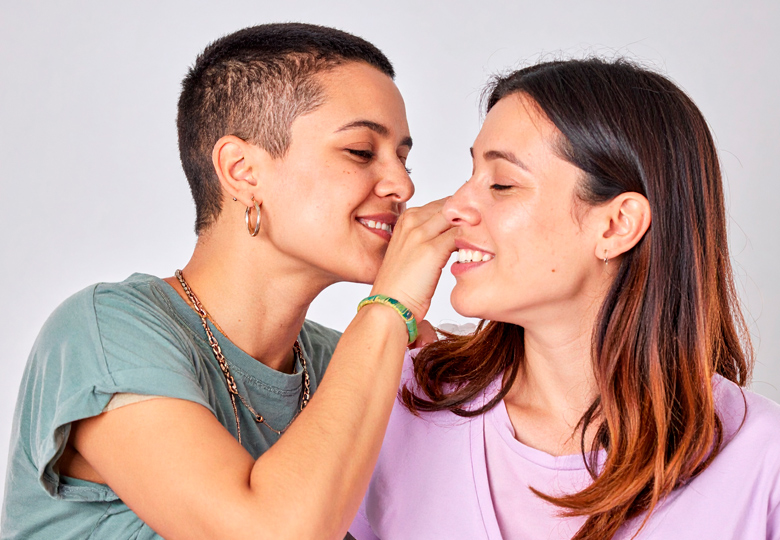
Every April 26, Spain joins in a celebration that is much more than a date on the calendar: Lesbian Visibility Day. A necessary day to recognize women who, historically, have been made invisible in public, political, cultural and media spaces. A day to say: we are here, we exist, we resist and we love with pride.
Although the advances in LGTBIQ+ rights in Spain are undeniable, the reality is that being a lesbian continues to imply, in many cases, facing social barriers, stigma and discrimination. Therefore, visibility is not only a symbolic act, but also a tool for social transformation.
Why a Lesbian Visibility Day?
The need for this day arises from painful evidence: lesbians have been and continue to be one of the most forgotten and least represented lyrics of the collective. Both in the media and in public policies, the stories of women who love other women have been silenced or told from stereotypical perspectives.
Faced with that, Lesbian Visibility Day is a collective response. A cry of presence that challenges historical marginalization and celebrates the diversity of identities, bodies and loves. It is not just about showing references, but about opening paths so that future generations can live their orientation without fear or shame.
A little history
Lesbian Visibility Day began to be celebrated in Spain in 2008, promoted by feminist activists and LGTBIQ+ organizations who understood that it was not enough to integrate the “L” in the acronym: it was necessary to put it in the center, to give it its own voice.
Since then, every April 26, marches, cultural events, debates and awareness campaigns are organized throughout the country. These actions not only seek to give prominence to lesbian women, but also to denounce the multiple forms of discrimination that persist: from workplace invisibility to corrective sexual violence.
The importance of references
Having visible references is vital. For a teenager just coming out, knowing that there are happy, successful and respected lesbian women can make a huge difference. It is a way of understanding that your orientation is not a problem or a condemnation.
In Spain, figures such as the politician Carla Antonelli, the soccer player Verónica Boquete or the writer and activist Itziar Ziga have helped open the gap. But there is still a long way to go. Representation continues to be scarce, and sometimes stereotyped or limited to certain cultural areas.
A question arises here: who tells the stories of lesbians? Who has the power to represent them in cinema, television, literature? And more importantly: how many stories remain untold?
Current challenges
Despite the achievements made, being visible as a lesbian in Spain still entails risks. The fear of rejection in the workplace, the lack of recognition in health systems or the social pressure to “adapt” to heterosexual norms are still present.
In addition, many lesbians face double discrimination: for being women and for their orientation. This intersection of oppressions is felt in the wage gap, in gender violence, in the lack of access to fertility treatments or in invisibility within the feminist movement itself.
Therefore, April 26 is not just a celebration. It is also a reminder that the fight for real equality continues.
What can we do to promote visibility?
The response is not unique, but multiple. Here are some keys:
- Support lesbian creators, artists and activists.
- Demand public policies that recognize and protect their specific rights.
- Make visible diverse relationships in the media and popular culture.
- Educate from childhood on emotional and sexual diversity.
- Listen to the voices of lesbian women themselves without trying to speak for them.
Promoting visibility means breaking years of imposed silences. And it also implies reviewing our own prejudices, our omissions, our small complicities with a system that still marginalizes.
A necessary critical look
However, not everything is celebration without nuances. Some voices within the LGTBIQ+ movement itself point out that Lesbian Visibility Day runs the risk of becoming a superficial event if it is not accompanied by real changes. What good is a photo with rainbow flags if, the next day, lesbian women continue to be discriminated against at work or in their doctor’s office? To what extent do big brands use April 26 as a marketing strategy without a real commitment to human rights?
These reflections invite us not to lose focus: visibility is not an end in itself, but a means to achieve deep and sustained equality over time.
Looking ahead
The future of lesbian visibility in Spain is in our hands. It is built in every daily conversation, in every shared story, in every space conquered. It is not enough to applaud one day a year: a real, collective and constant commitment is necessary.
Because as long as there is only one girl who thinks she must hide who she loves to be accepted, April 26 will continue to be urgent. And as long as there is someone who dares to love freely, despite fear, there will be hope.