
An unexpected decision leaves several key LGTBIQ+ Pride events in Vallecas in the air
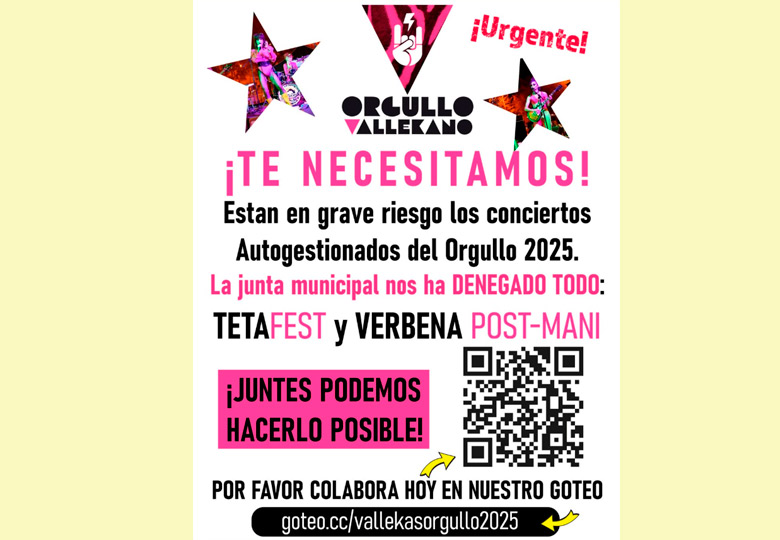
A few days before the start of Vallekano Pride, the Municipal Board of Puente de Vallecas has announced the withdrawal of technical and material support that allows the celebration of several of its most significant events. The notice, received without prior formal notice or clear technical justification, directly affects Tetafest—a festive and protest event for the LGTBIQ+ collective—and the concerts that traditionally close the annual demonstration for the rights of the community.
From the collective Orgullo Vallekano, organizer of the activities, they interpret the measure as a political decision rather than a technical one. They claim that the event had been included in the district’s official festival calendar for months and had the verbal approval of the Board until just a few weeks ago. But everything changed on May 20, when they received an email informing them that they would not have a stage, sound, lighting, bathrooms or any type of public infrastructure. Without clear explanations.
An administrative matter or a political gesture?
The Madrid City Council, for its part, maintains that the authorization was “inadmissible” due to errors in the way it was requested. According to municipal sources, the organization presented an application on May 12 to hold activities in the park on Diligencia Street, but did not accompany the documentation with a request for a temporary activity license, as established by current regulations.
Three days later – they say from the council – they were informed of the correct procedure. However, the group submitted the complete application on the 19th, after the deadline. The City Council insists that it is not about censorship, but about strict compliance with the procedures.
The neighborhood responds: solidarity in the face of uncertainty
Faced with this scenario, the neighborhood response has not been long in coming. From Orgullo Vallekano they assure that, despite the withdrawal of institutional support, the Tetafest will go ahead. It will do so thanks to the support of the neighborhood and the solidarity networks that are already working to cover the logistics. “It is not the first time that we organize without public resources, but it is outrageous that we have to do so due to such an arbitrary decision,” the group denounces.
The same does not happen with the closing concerts of Pride, whose realization remains in doubt due to the technical and legal complexity involved in organizing an event of that size without municipal help.
An isolated case or a worrying trend?
The organization points out that this situation is not new. They assure that the Municipal Board is progressively dismantling spaces for community participation. They cite as recent examples the cancellation of the traditional republican paella at the Ateneo, the La Villana festivities or the lack of resources for other popular activities in the neighborhood.
In addition, they link the withdrawal of support for Vallekano Pride with a protest organized on May 18 against the participation of an author accused of her transphobic speeches at the Vallecas Book Fair. “It was a peaceful casserole. Two days later, they took our resources away,” says Ana, spokesperson for the group. “It’s not just about Pride. It’s a way to punish any form of popular organization that falls outside the institutional framework.”
Neutrality or institutional control?
The line between technical management and political intervention is not always easy to draw. Can a public administration withdraw from supporting an already approved community celebration without raising suspicion? What room is there for neighborhood dissent in the use of public space? Although the City Council insists that there are no ideological motivations, the perception in the neighborhood is different.
This case invites us to reflect on the extent to which bureaucracy can become a weapon of control. And also about what role the public should play in protecting the rights and free expression of its citizens, especially those who have historically been excluded.
A critical look: are we facing covert censorship?
Although the City Council claims to have followed established procedures, the timing and circumstances of this withdrawal raise reasonable doubts. Is this just an administrative issue or are we facing a veiled form of institutional censorship? Some voices in the district point to a deliberate strategy of weakening the neighborhood and LGTBIQ+ fabric that is more uncomfortable for the authorities. Others point out that it could be bureaucratic clumsiness, but equally harmful. Be that as it may, the lack of transparency and perceived arbitrariness erode trust between institutions and citizens.