
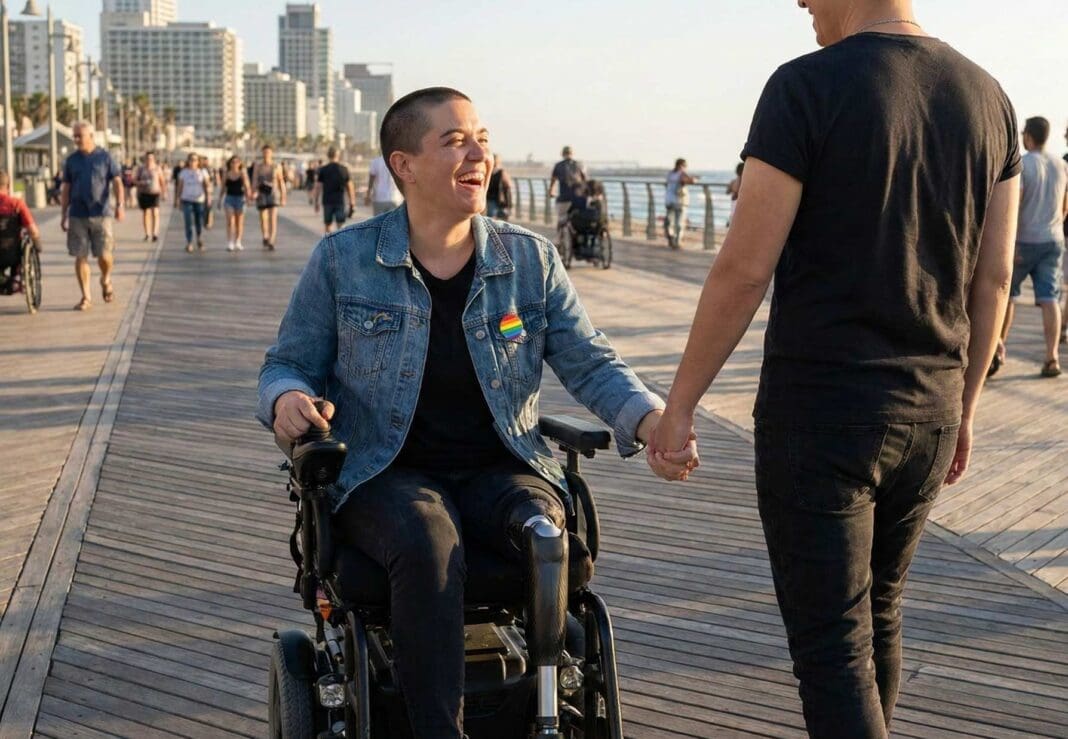
There are discriminations that do not add up: they multiply. It’s not a metaphor. It is a daily experience for many LGTBIQ+ people with disabilities who live at the intersection of two systems that exclude, infantilize or directly erase. When we talk about double discrimination we are not pointing out a nuance; We are naming a structure that fails, time and time again, to those who already start with less margin.
The intersection that bothers (and is therefore ignored)
For years, activism has advanced along parallel tracks. The movement for the rights of people with disabilities, on the one hand. The LGTBIQ+ fight, on the other. What happens when a person belongs to both spaces? Silence occurs. It just so happens that it doesn’t quite fit into any of them. It happens that it is seen as an exception, as a rare case, as a “complex issue” that is postponed.
Intersectionality is not a fashionable word: it is a tool to understand complex realities. And here complexity is uncomfortable because it forces us to review privileges within our own movements. How many LGTBIQ+ spaces are really accessible? How many campaigns talk about desire, pleasure and autonomy without falling into infantilization when disability appears?
Sexuality denied, desire guarded
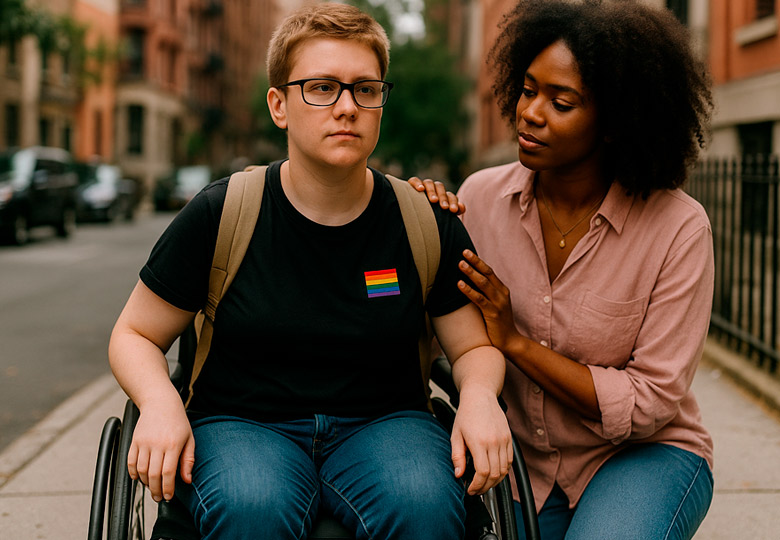
There is a persistent and harmful prejudice: that people with disabilities do not have sexuality. Or worse, that they should not have it. If they are also LGTBIQ+, the stigma doubles. Their ability to decide, to consent, to love is questioned. Their bodies and their affections are monitored with an intensity that does not apply to the rest.
In medical consultations, in educational centers, in residences, in well-intentioned families. The message is repeated: “it is not the time”, “it is not necessary”, “it is not appropriate”. For whom? Who decides which bodies are worthy of desire and which should remain neutral, asexual, silent?
The denial of sexuality is a form of violence. So is the lack of accessible, diverse and adapted sexual education. Without information there is no autonomy. Without autonomy there are no real rights.
Double wardrobe, double tiredness
Coming out of the closet is not a single act. For many people it is an ongoing process. Those who live with disabilities know it well: there is a closet for sexual orientation or gender identity and another for disability. Sometimes you leave one to hide in the other.
In LGTBIQ+ environments, there is a fear of being seen only as “the person with a disability.” In disability spaces, people avoid talking about sexual diversity for fear of rejection. This constant back and forth wears you down. Tired. Isolate.
Who supports those who always live explaining themselves? Who listens when fatigue is not just physical, but structural?
Specific violence, generic responses
Violence does not appear the same for everyone. LGTBIQ+ people with disabilities face higher rates of harassment, abuse and sexual violence. And yet, care resources are rarely prepared to address this reality.
There is a lack of interpreters, easy reading, professionals trained in sexual and gender diversity, and protocols that contemplate the intersection. There are plenty of inaccessible forms, prejudices, and condescending looks. There are plenty of excuses.
To talk about double discrimination without providing specific resources is to stop halfway. And no one is half-protected.
Representation: being is not the same as being visible
Representation matters, but not just any representation. It is not enough to appear in the background of a campaign or in a stock photo. We need protagonism, our own story, real diversity of bodies, abilities and desires.
We need LGTBIQ+ leaders with disabilities who are not there to inspire pity or heroism, but to exist. To love. To be wrong. To have a complex and complete life.
When you don’t see yourself, you doubt your place in the world. And when you hesitate too long, the world ends up convincing you that it doesn’t belong to you.
What do we have to review as a community?
This is not an article to point fingers at. It is an invitation—uncomfortable, yes—to look within.
- Are our events accessible or are they just “trying to be”?
- Does our language really include or only on paper?
- Do we listen to LGTBIQ+ people with disabilities or do we speak for them?
- Are we willing to give up space, focus and power?
Inclusion is not aesthetic. It’s politics. And demands resignations.
It is not an addition: it is a priority
Double discrimination cannot continue to be a secondary issue, a small section in extensive reports, a footnote in activism. It is an urgent reality that crosses concrete lives, here and now.
Defending LGTBIQ+ rights without including people with disabilities is building half-way equality. And half-equalities always leave someone out.
The question is not whether we are prepared for this debate. The question is: how much more harm are we willing to normalize while looking the other way?