
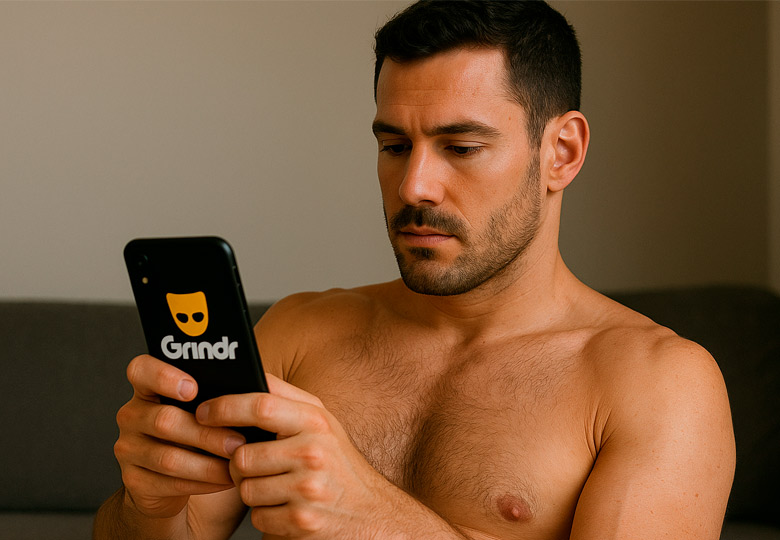
The hidden side of dating apps
Grindr, one of the most popular applications among LGTBIQ+ people to meet others, flirt or simply socialize, has revolutionized the way we relate. However, it has also opened the door to inconspicuous risks, including fake profiles.
The promise of immediacy, anonymity and closeness makes Grindr an ideal space… but also fertile ground for those seeking to manipulate, deceive or even scam. How can we protect ourselves without giving up the possibility of connecting?
This article seeks to shed light on a real, growing problem that especially affects vulnerable groups like ours. Not to raise alarm, but to encourage safer and more conscious browsing.

What is a fake profile and why should you worry?
A fake profile is a fabricated or manipulated identity that someone creates within the app. They may use stolen photos, misleading descriptions, or simply act suspiciously. Sometimes their goal is economic fraud. Others are harassment, extortion or even surveillance of LGTBIQ+ people in countries where our rights are not guaranteed.
It’s not just about “weird people.” Behind some fake profiles there are organized networks, automated bots or even groups that seek to identify LGTBIQ+ people to expose them publicly. Does it look like a spy movie? It is. But it happens.
Keys to identify a suspicious profile
There is no foolproof formula, but there are warning signs. Here are some of the most common:
- Photos that are too perfect or taken from image banks. If she looks like a catalog model, she may not be real.
- Little information in the bio or evasive answers when asked something specific.
- Hurry to take the conversation outside the app, especially to other platforms such as WhatsApp or Telegram.
- Unusual requests, such as sending compromised photos or making money transfers.
- Conflicting location or frequent changes in geographic distance.
Intuition also counts. If something doesn’t add up, if you feel uncomfortable, or if the conversation takes a strange turn, don’t feel obligated to continue. Trust that instinct.
How to actively protect yourself
In addition to being alert, there are concrete measures you can take to reduce the risk of coming across fake profiles or falling into their traps:
1. Verify what you can
Ask open questions, ask for more photos (always with respect) or suggest a video call if you feel confident. Many times, that alone unmasks someone who is not who they say they are.
2. Control what you share
Avoid sending intimate photos to strangers. Even if there is a connection, even if it seems “real.” Once submitted, an image is no longer under your control. The same applies to personal data such as address, place of work or routines.
3. Use the app’s security tools
Grindr allows blocking, reporting and muting. Feel free to use those features. They are there to protect you. Also, pay attention to updates: sometimes they bring important security and privacy improvements.
4. Stay in the app as much as you can
Moving quickly to other platforms can be risky. Grindr has certain protections that are not present in other apps.

5. Talk to others
Collective experience is key. Sharing what has happened to you can help others not go through the same thing. In some countries, there are even community groups where dangerous profiles are warned.
What is Grindr doing about it?
Grindr has implemented measures against fake profiles, such as automated detection systems and manual reporting. It has also been criticized for not acting quickly enough or for not prioritizing security in some contexts.
In 2021, for example, it became known that location data had been used to track LGTBIQ+ people in countries where being who you are can cost you your life. Since then, the app has improved some features, but the feeling that there is still a lot to do remains.
Should it be the users’ total responsibility to protect themselves? Or should we demand more from the platforms that profit from our interactions?
A critical look: are we assuming too much?
It is important to pause and reflect: why do we have to carry so much responsibility to be safe in a space that is promised to us as free and diverse? This individualistic approach can make structural problems invisible, such as the lack of specific legislation, the opacity of technology companies, or the absence of community care mechanisms. Furthermore, not everyone has the same emotional or digital tools to identify danger. Maybe, instead of just protecting ourselves, we should organize.
Navigate without fear, but carefully
Using Grindr—like any social network or dating app—does not have to be a traumatic experience. With caution, common sense, and a little strategy, it is possible to enjoy authentic connections without exposing yourself unnecessarily.
The key is to inform yourself, share experiences and always maintain a reasonable margin of doubt. In a hyperconnected world, taking care of your security is also a way of taking care of your freedom.
There is no magic solution. But there is something we can do: talk about this. Normalize that not everyone in the app is who they say they are. And that protecting yourself is not being paranoid, but responsible.