


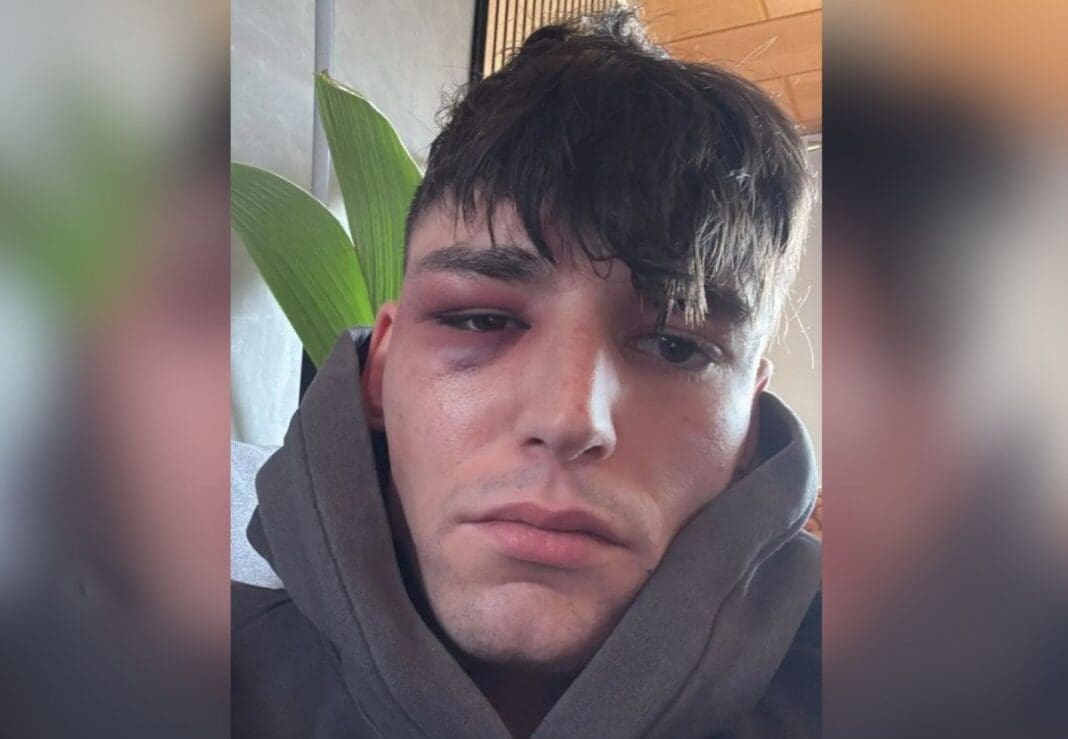
A week after starring in a moment that went viral for its bravery and tenderness, German referee Pascal Kaiser has been the victim of a violent assault in his own home. The incident, reported by the French sports media L’Équipe, has generated deep concern, as the young man attributes the attack to the visibility he acquired by proposing to his partner, Moritz, in front of more than 40,000 spectators during a Bundesliga match.
Last weekend, the emotional scene at the RheinEnergieStadion in Cologne, where Kaiser knelt, microphone in hand, during the match between FC Köln and Wolfsburg to ask the big question, was an open challenge to the prejudices that still dominate football. However, the joy was brutally interrupted by the reality of intolerance.
View this post on Instagram
From Celebration to Explicit Threats
The transition between celebration and attack was alarmingly rapid. Just a few days after his romantic proposal, Kaiser began receiving explicit threats that even included his home address. Despite contacting the authorities, who, according to their statements, did not consider that there was an “immediate risk”, the attack was carried out.
On the night of Saturday to Sunday, just twenty minutes after his last communication with the police, the referee amateur was intercepted by three men in the garden of his house, while he was going out to smoke. The violence of the assault has left him, among other injuries, a visible bruise on his eye. right, as L’Équipe has been able to verify through an image sent by the Kaiser himself.
For the reader, this forces us to reflect: how is it possible that an act of love and public visibility triggers such a brutal reaction in the 21st century? What message does the fact that bravery is punished with violence, even with police intervention involved, send to the LGTBIQ+ community?
Football: A Wall Still to Break Down for the LGTBIQ+ Community
The Pascal Kaiser case is not an isolated event; It is a symptom of a structural problem. Football, especially in men’s leagues and globally, remains a highly masculinized environment where homosexuality remains a taboo topic. Although figures like Kaiser take a step forward by making their sexual orientation visible – he did so three years ago – there are few active footballers who dare to do so, even in countries with social progress.
The situation in Spain is a clear example. It is difficult to find examples of elite players who have “come out of the closet.” This silence is not due to the absence of diversity, but to the obstacle that internalized homophobia and fear of reprisals (whether from fans, clubs or even the environment) pose for one’s professional career and personal life. The attack on Kaiser highlights the fine line between social applause and extreme violence.
Visibility is crucial, but it comes at a price. And that price, sometimes, is physical and emotional security. It is up to the sports industry, the clubs and the fans to demonstrate that football is a space for everyone, regardless of sexual orientation.
Reflection for the reader: If the simple fact of being visible can cost an attack, what can we do as a sociologist, as a journalist, as a fan and as a politician, to guarantee that diversity is not only tolerated, but actively protected in mass sport? Let’s think about how to support those who challenge the silence and what responsibilities we have as a society to eradicate these attacks.