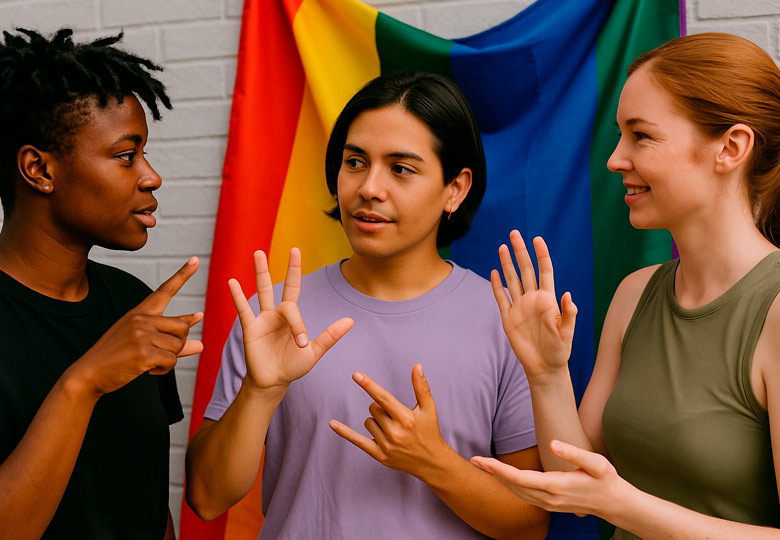
Every June 14, the National Day of Spanish Sign Languages is celebrated in the Spanish State, officially recognizing the Spanish Sign Language (LSE) and the Catalan Sign Language (LSC).
A day that is not shouted, but that is signed. A day that makes visible a way of communicating that does not need a voice to be powerful.
And yet, it continues to be made invisible by a large part of society.

This article is an invitation to look at (and not just hear) diversity from another angle: one where the linguistic, the sensory, the identity and the queer intersect.
🖐 What do we celebrate on June 14?
On June 14, 1936, Félix-Jesús Pinedo was born, a key figure in the associative movement of deaf people in Spain. In his honor, this date was chosen to commemorate the struggle and recognition of sign languages.
This day claims:
- The official status and free use of the LSE and the LSC.
- The right of deaf people to access information, education and culture in their language.
- The defense of a linguistic and cultural identity that has not always been valued as it deserves.
And although there is progress (such as Law 27/2007 or the inclusion of interpreters in some public events), sign language is still not fully guaranteed in health, justice, education or the media.
👁 Diversity that is expressed with the hands
Sign languages are not mimicry or literal translations of Spanish or Catalan.
They are complete languages, with their own grammar, syntax, lexicon and dialect variations.
And above all, they are languages that structure the way of thinking, feeling, creating and living of those who use them.
For many deaf people, the LSE or LSC is not a tool: it is an inseparable part of their identity.
And to recognize that is to recognize a cultural and linguistic community that has been historically marginalized.

🏳️🌈 And what does this have to do with LGTBIQ+ diversity?
Much more than you think.
💥 Double discrimination
A deaf LGTBIQ+ person can face double invisibility: for not conforming to the hearing norm, and for not conforming to the cishetero norm.
Where are the deaf people in queer spaces? What about LGTBIQ+ people in the deaf community?
💬 Communication barriers
Many LGTBIQ+ resources are not available in sign language.
Neither sexual health campaigns, nor talks on gender identity, nor inclusive cultural content usually have an interpreter or are adapted.
And that leaves a lot of people out.
✨ Spirituality, body, desire
In sign language, the body is the main communication tool. And that generates a different relationship with gender, expression, desire.
For many deaf queer people, signing their identity is also a way to empower themselves from the physical, the visible and the symbolic.
🧠 Language, identity and intersectionality
Recognizing sign languages as our own languages is not just a matter of accessibility. It is also a question of cultural rights, symbolic recognition and linguistic justice.
And from an intersectional perspective, it is urgent:
-
Incorporate sign language in feminist, queer, anti-racist and diverse spaces.
-
Ensure that deaf people are not treated as minors or as eternally “dependent.”
-
Prevent ableism, monolingualism and LGTBIQ+phobia from intersecting to exclude those who live several identities at the same time.
🔎 Critical reflection: what if the LGTBIQ+ collective itself is also exclusive?
It’s hard to say, but necessary.
Many queer events, talks, publications or parties do not take accessibility into account.
There is no interpreter, there are no subtitles, there is no visual support, there is no clear information.
And that sends an implicit message: “if you don’t understand, it’s not your place.”
Are we willing to review our hearing privileges?
Are we wondering about inclusion beyond the multicolored flag?
🤲 How can we accompany from outside?
Here are some keys to celebrate this day (and the rest of the year) since the engagement:
✅ Use your hands: learn the basics
Learning greetings, colors or pronouns in LSE or LSC does not change the world, but it can open a conversation with someone who is not usually listened to.
✅ Demand real accessibility
At your work, cultural center or LGTBIQ+ event, ask for an interpreter, subtitles or easy reading. It’s not a luxury. It is a right.
✅ Support deaf and queer creators
Follow them on networks, spread their content, attend their talks. There are incredible activists, artists and communicators who sign, and they do it with force.
✅ Ask before assuming
Not all deaf people use sign language. And not all of them want to be publicly visible. Accessibility begins with listening.
📣 Conclusion: our languages are also our struggles
Speak, sign, write, create.
They are all ways of existing.
And in the case of sign languages, they are also ways of resisting.
This June 14 is not just another anniversary. It is a reminder that there are many ways to inhabit language, and that they all deserve space, respect and visibility.
Because hands also tell stories.
And if we learn to look, we will discover everything they have been trying to tell us for years.