


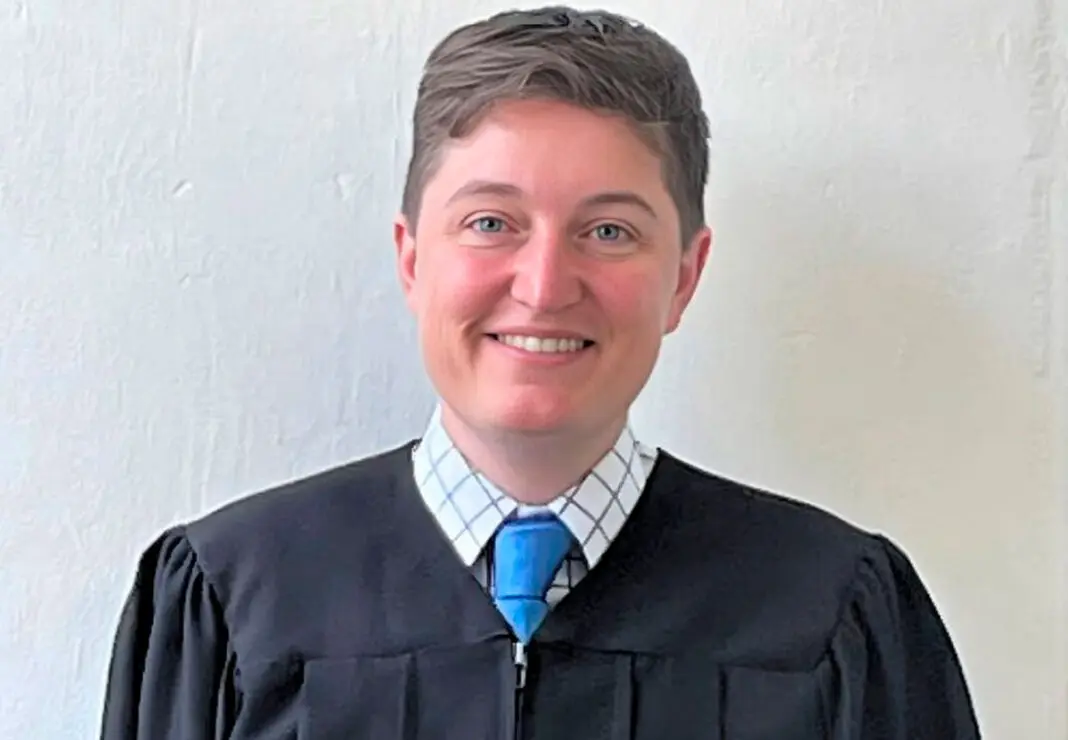

Imagine a justice system where every voice, every identity, can feel seen and understood. In the state of Massachusetts, United States, a significant leap has just been made in that direction. The LGTBIQ+ community celebrates a highly relevant milestone with the appointment of Connor M. Barusch, who becomes the first transgender and non-binary person to assume the position of judge in its judicial branch. News that invites us to reflect on the arduous path towards more inclusive justice.
A trajectory marked by public defense
Accessing a position in the judiciary in the United States is a complex challenge, even more so for candidates who openly identify themselves as Barusch. Without the competitive examination system that we know in Spain, his path has required unwavering dedication, even with a degree from the prestigious Harvard University.
Barusch, with an unquestionable record of social commitment, dedicated a decade, from 2011 to 2025, to the Public Counsel Services Committee. This role, analogous to our office in Spain, operates under a public defender system funded by the State of Massachusetts to guarantee the defense of those who lack means.

During his service in Suffolk County, Barusch dealt with a wide spectrum of cases, from misdemeanors to murder situations. His interest focused especially on litigation with racial implications and those that required in-depth analysis of scientific or technological evidence. In addition to her work in court, she dedicated herself to training other public defenders nationwide, actively teaching on how to provide more effective legal representation to transgender clients. Prior to this, he was also part of a family law firm with a special focus on legal matters for LGTBIQ+ clients.
The rigorous appointment process
Unlike other systems, appointment in Massachusetts is an exhaustive process with multiple layers of review. This mechanism seeks to ensure the technical and ethical suitability of the applicants:
- Judicial Nominations Commission (JNC): A panel composed of legal professionals and experts that evaluates candidates. This phase includes professional and ethical background checks, and interviews that are often initially anonymous to ensure impartiality. Applicants must detail their most important cases and declare any lobbying activities. Barusch spent two years preparing his candidacy.
- Governor’s Council: After passing the JNC, candidates must obtain the final approval of this body of eight elected councilors. It involves submitting additional references and undergoing questioning at a public hearing, where your technical competence, ethical conduct, and ability to deliver justice are examined.
The ratification came from Governor Maura Healey (of the Democratic Party and progressive tendency), formalizing the appointment in February 2025. A more representative justice
The significance of this appointment goes beyond Judge Barusch’s personal achievements; represents an advance in the vision of justice. Speaking to Justice Law 360, Barusch shared a powerful reflection on her identity and her new role: “My experience as a trans and non-binary person has helped me listen much better and perhaps made me empathize or better understand people who are very different from me in different ways.”
Its objective is clear: “to contribute to a more representative and diverse justice.”
The access of openly transgender and non-binary people to positions of such high responsibility in the judicial system is crucial. Diversity in the courts not only offers a message of hope and validation to all citizens, but also enriches decision-making by incorporating perspectives that have historically been marginalized.
How do you think the inclusion of diverse life experiences, like Barusch’s, can transform the way justice is administered and the rights of the LGTBIQ+ community are perceived in the future? Are we really building a system where equity is the norm, not the exception?