

As a trans man, I sometimes feel like I invade feminist spaces by wanting to give my opinion, and it is also difficult for me to translate that discourse to my own situation. Identifying with this causes me a certain dysphoria, but ignoring that there are common points would be foolish.
After years of encounters with gay men who celebrated my “vagina” as an exotic trophy or an experiment, I was struck by a question that still burns me: Can a trans man suffer sexist violence at the exact moment he takes off his clothes?
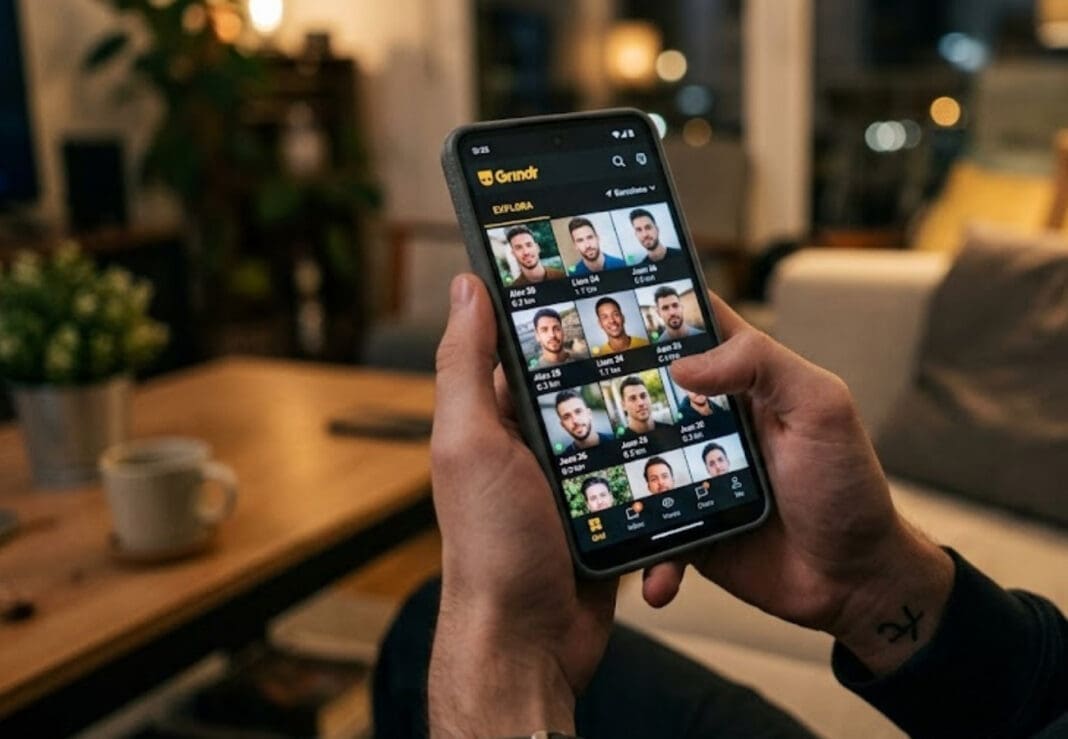
I started using dating apps like Grindr when I was around 20 years old, after having been on hormone treatment for some time. At first, I was looking to find people from the group: I lived in a small town where there was hardly any LGBT community and I wanted to create bonds and friendships. But the reality of these applications tends to quickly lean towards the sexual.
At first I thought that if I was valued sexually by gay men, it meant I had “succeeded” as a trans man; If they got excited about me, it was because they saw me as one of them. But that idea was shattered again and again after each encounter, when I heard phrases like: “I so wanted to try sex with someone with a vagina”, “You’re the first guy “like that” I’ve slept with” or “Whenever I see a trans guy on Grindr I write to him, you make me really horny.” Approval always passed through my genitals before my person.
At the end, another doubt returned: if I am treated for my genitals, socially categorized as female, to what extent am I being read as ‘a woman’?”
Another conviction that led me to make mistakes was believing that, at 19 or 20 years old, I attracted mature men because I was “more cultured and interesting than average.” The reality is that I have never looked my age, they have asked me for my ID until I was 25; At 19, he seemed extremely young, and to that we had to add the genital issue. Was it a gift for those men in search of their own “Lolita” or “Lolito”?
In express sex applications where male bodies are expected, encountering genitals that are read as female generates very specific dynamics. A fear that I have always had is that this thought would appear in the heads of those men: “Fuck, perfect: a young and easy pussy that I can fuck.” It is a projection, yes, but one that has hurt me and that I have repeated to myself many times.
At that age you are not there to theorize about any of this; You have enough to sustain your own transition. When socializing as a woman during the first half of your life, you have a clear idea: “being promiscuous is for whores.” Then, when socializing as a gay man, another cliché appears: “faggots are vicious.” I became “a vicious person”, but did my vagina become a “whore”?
At that time he defended the sexual revolution. I even came to accept the fetish linked to my condition and take advantage of it. You feel powerful, almost high, when your profile generates desire. You start treating yourself like “the TRANS guy.”: something that used to bother you, now you don’t care because it’s what attracts you, what makes you “special.” You don’t realize how your self-perception changes when you constantly expose yourself to relationships that last as long as fast food.
I have heard testimonies from transsexual boys that, if told by women, would have set off all my alarms: I would have thought about filing complaints or the police. But too many things intersect here. Sexual violence in encounters that arise from applications seems to be assumed and made invisible. It may be due to fear of the institutional response, because it is perceived as an inherent risk of meeting strangers or because, due to its frequency, it is no longer referred to as violence. Hegemonic masculinity also weighs in: the idea that a man cannot suffer abuse or that, if he tells it, he will only receive ridicule. Sometimes we ourselves do not recognize what we have experienced. If you put the gay factor and the trans factor together, the result is an experience that is very difficult to explain to yourself and to tell others.
There was an encounter that, over time, I have not stopped reviewing:
After sleeping with a guy I met through Grindr, practically without knowing each other, he started telling me that I was the man he had always been looking for. He explained to me that his family had rejected him for being gay, in part because that meant not having children. And, suddenly, he found a “solution” in me. A man with a vagina.
Someone with whom, according to him, everything could fit: his desire and his role as a “man.”
That same night they started talking about having a child together. Not as a distant idea, but as an immediate plan. In the following days, the insistence continued: messages about a couple, about the future, about pregnancy.
Beyond disconcerting, what I was left with was something else: the feeling that my body was being read as a function. As a tool capable of resolving someone else’s conflict.
A moment when you understand something uncomfortable: that if for the market you are a fetish, for the patriarchy you continue to be, above all, an available womb.
He had to spend time and get out of that circuit to be able to look at all this with some clarity.
I don’t know what my transition would have been like without those experiences, or if I would have built a different relationship with my body. What I do know is that for a long time I confused validation with desire and exposure with freedom. And that, in that process, I learned to inhabit an uncomfortable place: that of being read and exposing myself as someone with a condition rather than just a person.
So I return to the question that crossed my mind from the beginning: can a trans man suffer sexist violence the moment he takes off his clothes?
Maybe the answer is not so clean. Perhaps we are not facing closed categories. Because what appears in many of these encounters is a mixture that is difficult to separate: there is transphobia when your body is treated as an exception or an experiment; There is sexist logic when that same body is reduced to its reproductive function or its availability; and there is something more diffuse when all this occurs within a framework that you yourself have learned to desire.
Applications do not invent these dynamics, but they do intensify and order them. They do not create desire, but they channel it into quick, functional, interchangeable forms. And in that system, some bodies are more exposed to being consumed in very specific ways.
Naming this is not denying sexual freedom. It is, precisely, taking it seriously.
Because not everything that is experienced as a choice is free of conditions. And because sometimes violence does not appear as something external that is imposed, but as something that filters into the way we learn to bond, to desire and to offer ourselves.
Now, from the outside, he tried to reconstruct another way of being: slower, less consumer-oriented, less crossed by the need for immediate validation and with the need to make visible and give voice to something that in the past I could not find or do. It’s not always easy. But there is something I no longer want to negotiate again.
That feeling that my body and what I did with it were not entirely mine.