
- The Provincial Court of Palma revokes the dismissal and orders an investigation for a possible crime of scorn regarding the Santa Punxada poster, LGTBIQ+ party of Sant Sebastià.
- The defendants are Lucía Muñoz, leader of Podemos in Balears, and the illustrator Lluïsa Febrer. The complaint was filed by Abogados Cristianos and Vox.
- The court dismisses the hate crime and clarifies that its resolution does not declare that there is a crime nor assigns responsibilities.
The Santa Punxada poster returns to the courts. The Second Section of the Provincial Court of Palma has revoked the inadmissibility of the complaint from Abogados Cristianos, Vox, and their deputy Jorge Campos against Lucía Muñoz and Lluïsa Febrer, and orders an investigation into a possible crime of scorn, as was known on October 15, 2026.
What is the Santa Punxada?
The Santa Punxada is a reivindicative party for LGTBIQ+ rights that is celebrated every year during the Sant Sebastià festivities in Palma. It has the support of Podemos and was born as an alternative to the official program of the patronal festivities.
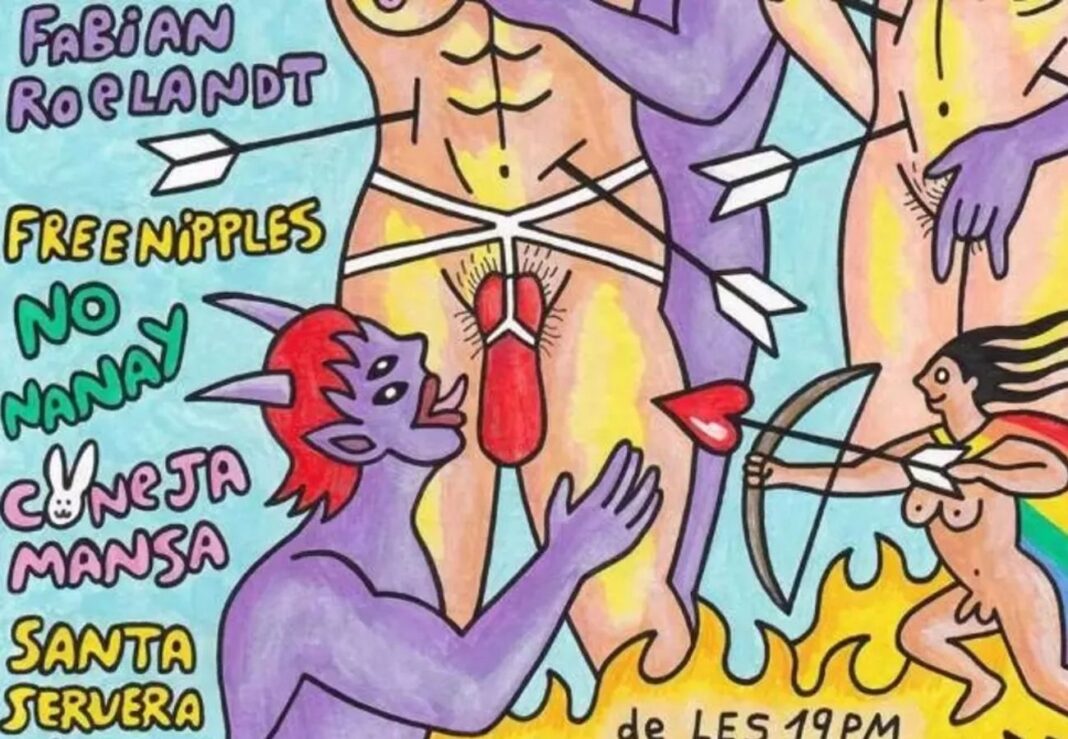
The poster of the edition released in January 2025 showed the patron of Palma with a sobrassada as a penis, a female version of the martyr, both surrounded by ‘dimonis’, and a figure of Jesus Christ as a DJ.

What has the Court of Palma decided?
The Court partially upholds the appeals and orders the admission of the complaint for a possible crime of scorn, as stated in article 525 of the Penal Code. The objective is to investigate with what intention the images were disseminated.
At the same time, the court maintains the inadmissibility for hate crime, considering that the facts do not contain elements of incitement to hatred or discrimination.
The resolution makes it clear that it does not declare that any crime has been committed nor determines responsibilities: it only opens the door to investigate.
Why had it been archived before?
In March 2025, a court in Palma inadmissibly filed the complaint considering the poster an artistic satirical manifestation without scorn towards the Catholic religion. Abogados Cristianos, Vox, and Jorge Campos appealed that decision, and now the Court partially gives them reason.
What the parties say
Lucía Muñoz defends freedom of expression and artistic creation: “We still think the same as on the first day.” She also recalls that the saint has been represented as a erotic symbol since the Renaissance: “We haven’t invented anything.”
Polonia Castellanos, president of Abogados Cristianos, celebrates the decision as “a very important victory” and argues that “Justice has made it clear that these facts could not be archived without investigation.”
The case once again pits s satire and queer culture against the judicial offensive of ultra-conservative entities, a clash that repeats in Spain every time LGTBIQ+ art touches religious symbols.
Frequently asked questions
What crime is being investigated regarding the poster?
For a possible crime of scorn (article 525 of the Penal Code). The court has dismissed the hate crime.
Who filed the complaint?
The Spanish Foundation Abogados Cristianos, Vox, and their deputy Jorge Campos.

Does this mean there is a conviction?
No. The Court clarifies that it does not declare that any crime has been committed nor determines responsibilities.
Who are the defendants?
Lucía Muñoz, leader of Podemos in Balears, and the illustrator Lluïsa Febrer.