

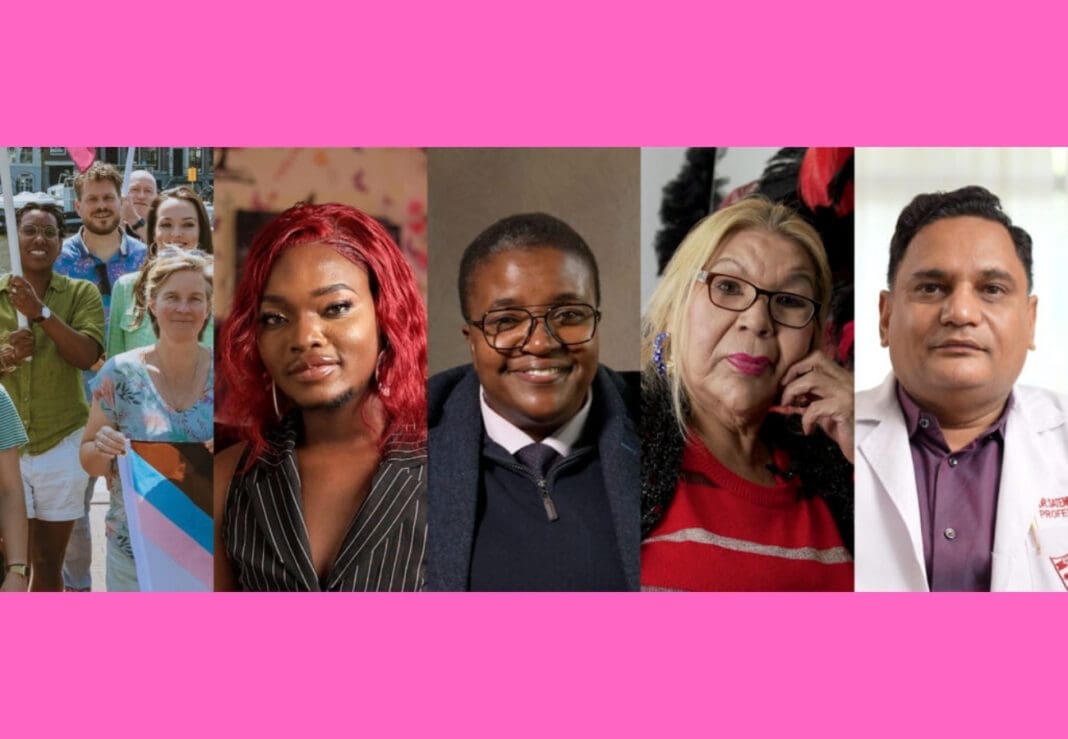
- UNDP and ILGA World honored five leaders of LGTBIQ+ equality on August 5 in Amsterdam.
- The recognitions encompass trans activism, memory, politics, associative movement, and alliances for inclusion.
- Awardees from low and middle-income countries will receive $10,000 in support of their work.
The International Pride Awards 2026 recognized five individuals and organizations from Uganda, South Africa, the Netherlands, Chile, and India on August 5 in Amsterdam. The event, organized by the United Nations Development Programme and ILGA World, was part of the WorldPride Human Rights Conference.
Five trajectories and a shared defense of equality
The 2026 edition brought together very different profiles under one idea: LGTBIQ+ rights advance when community work, public action, and sustained alliances become structures of real protection. The jury distinguished Aggie Dennett Harmon, Mmapaseka Steve Letsike, COC Nederland, Marcela Dimonty, and Dr. Satendra Singh.
Aggie Dennett Harmon is a trans pastor, rights advocate, and community leader from Uganda. She co-founded Talented Youth Community Fellowship Uganda, an organization led by trans women that provides psychosocial support, trauma-informed care, peer networking, and empowerment programs.
She also founded the Nange Healing and Harm Reduction Center, conceived as a safe and affirming space for trans people and those who use drugs. UNDP and ILGA World highlight that her work is particularly directed at those facing violence, displacement, and exclusion.
The recognition of Harmon focuses on a basic dimension of activism: the creation of networks that address immediate needs. Safety, psychological support, and harm reduction do not appear here as secondary issues, but as essential conditions for a person to exercise their rights.
From civil society to institutions
Mmapaseka Steve Letsike represents another path of transformation. The South African activist entered Parliament in 2024 and holds the position of Deputy Minister of Women, Youth, and Persons with Disabilities. Her previous trajectory developed in civil society and public health.
Her award recognizes the leap from community advocacy to institutional responsibility. This combination allows for the transfer of knowledge built alongside communities into the political space and links LGTBIQ+ equality with other public agendas, including health, youth, and disability.
COC Nederland, eight decades of collective organization
The award to COC Nederland broadens the focus from individual leaderships to the continuity of movements. Founded in 1946, it is the oldest active LGTBIQ+ organization in the world. According to information released by the awards, it collaborates with over 200 organizations in more than 35 countries.
Its inclusion among the five distinctions of 2026 underscores the importance of building organizations capable of supporting multiple generations. Associative work is not limited to responding to a specific crisis: it maintains networks, forms leaderships, and creates a common memory from which to defend new advances.
COC Nederland received the recognition in its own country during WorldPride Amsterdam. The choice connects the international dimension of the awards with an entity whose history is linked to the evolution of the Dutch movement and whose current activity extends far beyond its borders.
Marcela Dimonty: memory, truth, and reparation
Chilean trans activist Marcela Dimonty participated in the first documented gay demonstration in Chile, held in 1973. After the coup, she was detained and tortured during the dictatorship. Her subsequent trajectory has kept memory, truth, and reparation at the forefront.
The recognition rescues a part of history that often remains outside official narratives: the persecution suffered by LGTBIQ+ individuals in authoritarian contexts. By awarding Dimonty, the organization links the present of rights with the preservation of testimonies and the demand for justice for those who suffered state violence.
Satendra Singh and the value of responsible alliances
Indian doctor Satendra Singh, a defender of the rights of persons with disabilities, was recognized as an ally of LGTBIQ+ communities. A physician and educator, he has driven changes in healthcare training and in the language used by institutions.
Among his contributions, ILGA World and UNDP highlight his work against pathologization, his promotion of affirmative medical education for trans individuals, and his intervention to recommend avoiding medically unnecessary surgeries on intersex infants and minors in 2020.
His award conveys a precise idea about alliances: accompanying does not mean speaking on behalf of a community, but using one’s professional position to eliminate discriminatory practices and open institutions that have historically produced exclusion.
The International Pride Awards are a joint project of UNDP and ILGA World. The nominations were evaluated after a global nomination process, and awardees from low and middle-income countries will receive $10,000 to support their work. The ceremony was supported by Deutsche Bank and OUTtv.
In an edition that unites five continents and very different experiences, the result is a broad snapshot of social change: direct attention, community organization, historical memory, political action, and professional reform. There is no single way to defend equality, but all require continuity, resources, and public recognition.