
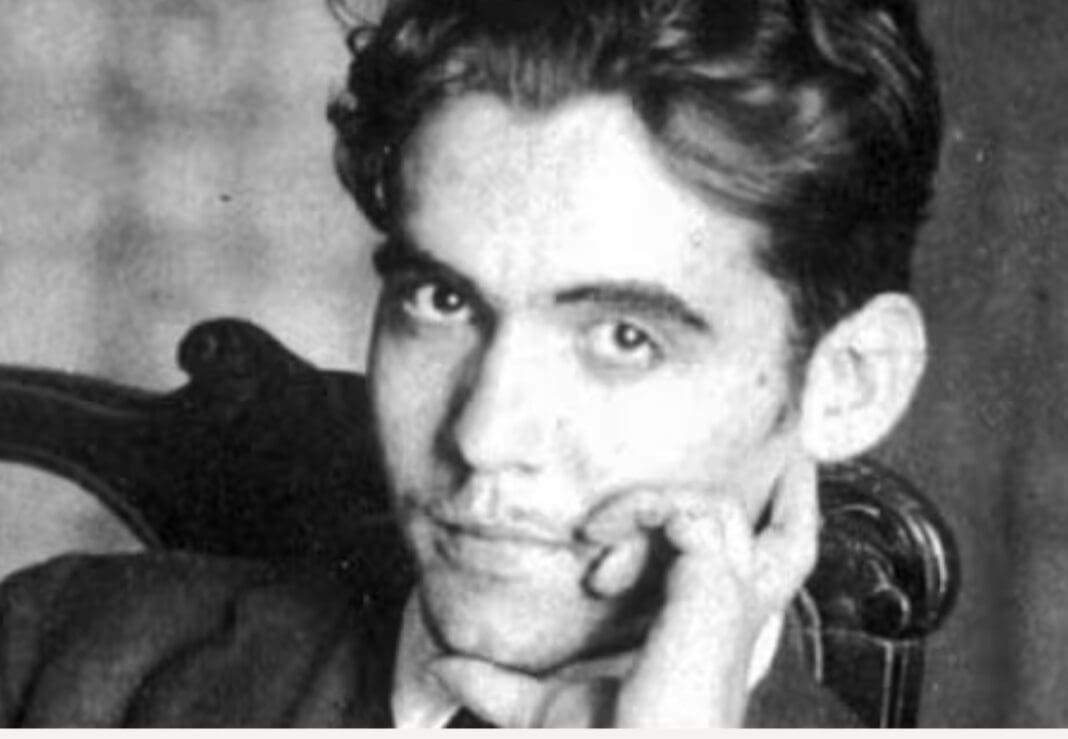
Federico García Lorca was a poet, playwright, artist, homosexual man, and a victim of violence that sought to silence him. Ninety years after his murder, his story continues to speak of freedom, memory, and diversity.
There are names that survive people.
Federico García Lorca is one of them.
This August 18 marks 90 years since his murder in Granada, during the early months of the Spanish Civil War. Ninety years later, his poems continue to be read, his works are still performed, and his figure remains one of the great cultural symbols of Spain. But knowing Lorca today implies something more than approaching one of the great writers of Spanish literature.
It implies asking ourselves what happens when a society turns difference into a threat.
Lorca was much more than a poet
Born in Fuente Vaqueros, Granada, in 1898, Federico García Lorca became one of the central figures of the Generation of ’27. He wrote poetry, theater, prose, drew, played music, and built a body of work traversed by some of the great themes of human existence: desire, death, freedom, frustration, identity, and the impossibility of living according to imposed norms.
By 1936 he had achieved enormous popularity. That same year he finished La casa de Bernarda Alba, one of his fundamental works. Shortly after, the military coup against the Republic radically changed the political and social landscape of Spain.
Lorca returned to Granada.
And there his tragedy began.
A homosexual man in a society that did not accept difference
Talking about Lorca from an LGTBIQ+ perspective does not mean reducing his work to his sexual orientation. It means, precisely, giving back a part of his history that was hidden for a long time.
Lorca was homosexual in a Spain where sexual diversity was marked by stigma, persecution, and silence. For decades, even after the Franco dictatorship, many accounts of his life avoided openly discussing his relationships and desires.
His homosexuality was turned into an uncomfortable topic for years.
Even after the dictatorship, that silence continued. Subsequent studies and publications have documented how Lorca’s sexual orientation was omitted or minimized for decades, while his work was often presented without addressing a fundamental dimension of his personal experience.
Today we can read Lorca differently.
Not to confine him to a label, but to better understand the man who wrote.
Why was he killed?
This is one of the most difficult questions.
Lorca was arrested on August 16, 1936, in Granada. He had sought refuge in the house of the Rosales family, linked to the Falange, but that did not protect him. He was taken to the Civil Government and later moved to the area of Víznar and Alfacar.
The exact circumstances of his murder and the specific responsibilities continue to be the subject of historical investigation.
But there is something that is fundamental: Lorca was a victim of the repressive violence unleashed after the military coup and the Civil War.
Among the elements that appear in the investigations about his detention are his political positions, his intellectual ties, and also explicit references to his homosexuality.
His body was never recovered.
And that absence is also part of his story.
A body that still does not appear
Perhaps one of the most powerful images of Lorca is precisely that:
a universal poet whose grave we still do not know.
The area of Víznar and Alfacar, where he was murdered, was the scene of numerous crimes and burials during the Francoist repression. The Junta de Andalucía itself recognizes that territory as a space of democratic memory.
That is why talking about Lorca is not just talking about literature.
It is talking about historical memory.
About missing persons.
About families that for decades could not know where their loved ones were.
About a society that is still trying to reconstruct the stories that were erased.
Lorca and freedom
There is another reason why Lorca remains profoundly contemporary.
His characters often face what society expects of them.
Women locked away.
Forbidden desires.
Impossible loves.
Monitored bodies.
People who want to escape a destiny that others have decided for them.
In La casa de Bernarda Alba, for example, authority, control over bodies and sexuality, and social pressure permeate the entire work.
In Yerma, the social mandate on motherhood becomes a tragedy.
In his poems, desire often appears accompanied by fear, loss, or impossibility.
Perhaps that is why his texts continue to challenge us.
Because Lorca’s questions still exist.
Who decides how we should live?
Who decides whom we can love?
Who establishes which bodies are acceptable?
Who has the right to be different?
From censorship to pride
For decades, Lorca’s story was told without telling it completely.
Today, the recovery of his homosexual dimension is also part of a broader story: that of LGTBIQ+ people who were forced to hide, silence themselves, or live in fear.
Lorca became over time a cultural reference for LGTBIQ+ generations.
And it is not casual.
His work constantly speaks of those who wish to break the limits imposed by others.
In 2026, an exhibition in Madrid dedicated to the history of sexual dissent in Spain places Federico García Lorca and Pedro Zerolo as two figures that allow us to traverse a century of transformations: from the repression of homosexuality to the conquest of rights such as equal marriage.
Ninety years later, Lorca is still here
This anniversary should not only serve to remember when Federico García Lorca died.
It should serve to ask ourselves why we still need to remember him.
Because a democratic society not only protects the freedom of those who are different.
It also remembers those who were persecuted for being so.
Because memory is not just about looking back.
It is also about deciding what kind of society we want to build moving forward.
This August 18, 90 years later, we can read Lorca again.
We can listen to his verses.
We can represent his works.
We can visit Granada and walk through the places that marked his life.
But, above all, we can do something that for too long was not possible:
to name him fully: Federico García Lorca.
Poet.
Playwright.
Artist.
Homosexual.
Victim of repression.
And, above all, a person whose work achieved something that those who tried to silence him could never prevent:
to keep speaking.
Ninety years later, Lorca continues to speak.
And we continue to listen.