


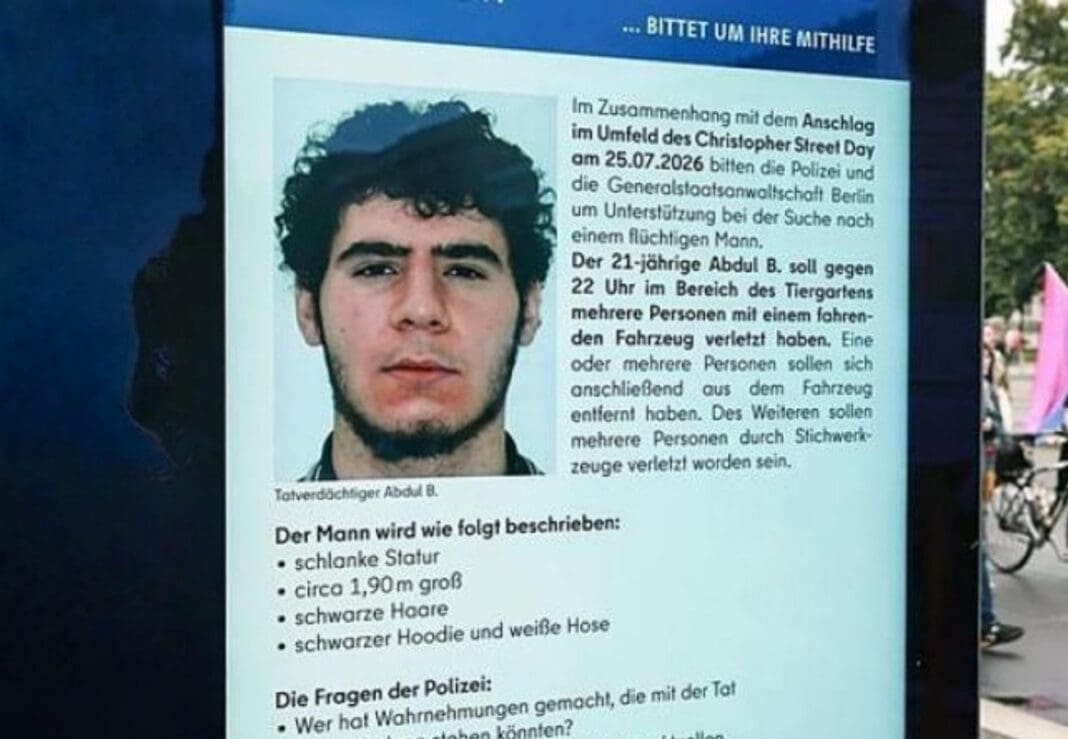
The attack that struck the Christopher Street Day (CSD) in Berlin not only left one dead and 29 injured. It also opened a deep debate in Germany about the management of extremists considered high-risk and the protection of large LGTBIQ+ events in Europe.
As the investigation progresses, authorities are trying to answer a question that currently dominates public debate: how could a person who had already been convicted of terrorism-related offenses carry out an attack of this magnitude?
A profile known to the authorities
The alleged perpetrator, Abdul Ballout, 21 years old and of German nationality, had been convicted months earlier for preparing a serious act of violence against the State. According to the German Federal Prosecutor’s Office, he had a history of Islamist extremism, had attempted to travel to join the so-called Islamic State, and was participating in a deradicalization program under judicial supervision.
After the attack, investigators found a video on his mobile phone in which he allegedly pledged allegiance to the Islamic State, as well as propaganda material found at his home. These elements reinforced the hypothesis that the attack was motivated by jihadist extremism.

Failures in the system.
The fact that Ballout was on probation has triggered a strong political controversy in Germany. Interior Minister Alexander Dobrindt announced a review of monitoring mechanisms for individuals considered dangerous and proposed tightening control tools, including the use of electronic devices for certain convicted terrorists.
Security specialists remind us that permanent surveillance of all radicalized individuals is practically impossible due to the resources it requires. However, the case has reopened the debate about whether the risk assessment was sufficient for a person with a history of violent extremism.
An attack directed against Pride
German authorities believe that the attack targeted one of the largest Pride celebrations in Europe. The attack occurred near the Brandenburg Gate, when tens of thousands of people were participating in the CSD parade in Berlin.
German Chancellor Friedrich Merz described the incident as a terrorist attack against democratic values and freedom, while LGTBIQ+ organizations insisted that the attack aimed to instill fear in a community that already faces an increase in hate speech in various European countries.
Europe responds with solidarity… and calls for more security
Rather than canceling the celebrations, various European cities responded with tributes, moments of silence, and a message of unity.
In Barcelona, organizations, institutions, and activists publicly expressed their solidarity with the victims and asserted that Pride will continue to be a space of freedom against hate.
A challenge for all of Europe
The Berlin attack once again places LGTBIQ+ events at the center of the debate on security, radicalization, and the protection of human rights.