

- A new analysis identifies projects with LGTBIQ+ preemption clauses in 48 states during 2025 and 2026.
- Preemption allows a state to prevent cities, counties, or districts from adopting their own protections.
- The vast majority of the 200 analyzed projects target trans and non-binary people.
The preemption of LGTBIQ+ rights has spread through state legislatures in the United States. A report published on August 5 examines 200 projects presented in 2025 and 2026 and detects proposals that limit local authority in 48 states, especially against trans and non-binary people.
What it means for a state to get ahead of a city
In U.S. law, preemption allows a state rule to displace or prohibit a municipal decision on the same matter. A legislature can thus prevent a city, county, school district, or other local authority from adopting more protective rules than those set by the state.
The mechanism is not new nor is it used solely in LGTBIQ+ matters. For years it has been discussed in relation to minimum wage, paid leave, housing, or labor regulation. However, the new analysis warns that it has also become a central tool for blocking local responses on equality.
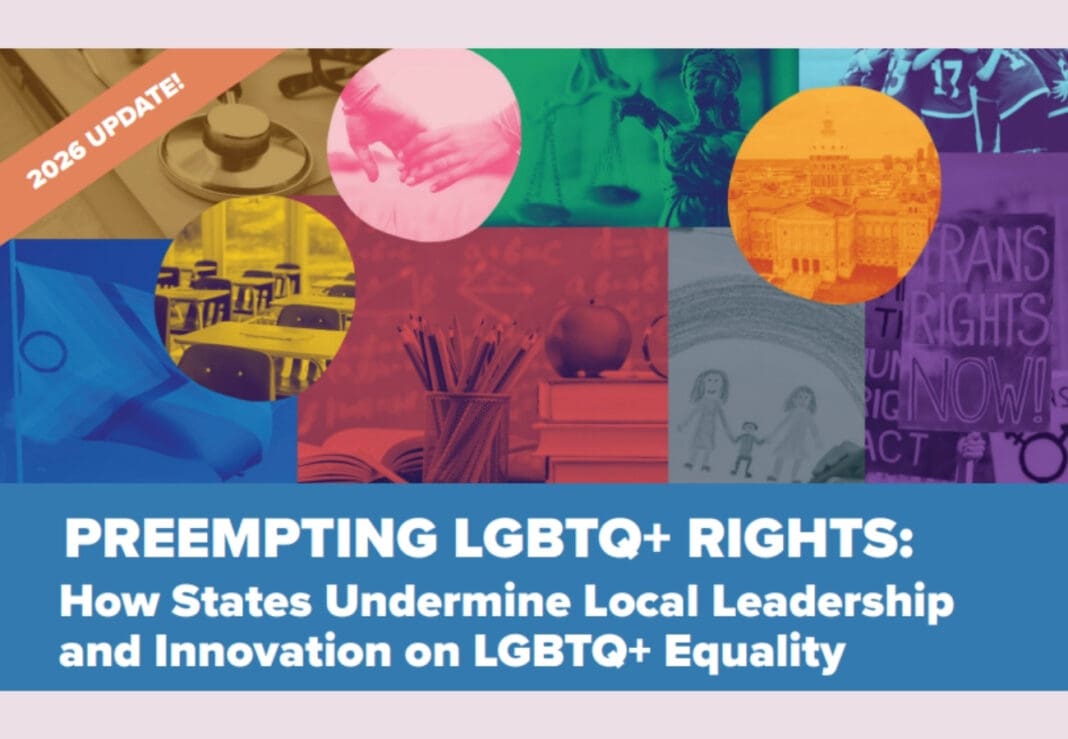
The report, titled Preempting LGBTQ+ Rights: How States Undermine Local Leadership and Innovation on LGBTQ+ Equality, updates a work published in 2024. It was prepared by Jesse Workman, senior attorney at A Better Balance, in collaboration with American Democracy Hub, Equality Federation, and Local Solutions Support Center.
Its authors studied 200 anti-LGTBIQ+ projects introduced during the legislative sessions of 2025 and 2026. They found preemption provisions in proposals from 48 states and concluded that the vast majority targeted trans and non-binary people.
The distance between a prohibition and its local effects
A law with preemption does not just impose a common rule. It also reduces the margin for communities to respond differently. A city that wants to protect its students, adapt a municipal service, or pass an anti-discrimination ordinance may find it lacks the authority to do so.
This effect explains the concern of the signing organizations. Local authorities are often the first point of contact for services, education, public employment, sports facilities, or coexistence. When the state restricts their capacity, the consequence is felt in everyday decisions and not just in major legislative debates.
Two hundred projects under the same lens
The value of the study lies in observing the projects as a whole. Analyzed separately, they may seem like interventions on different issues. Viewed comparatively, they show a strategy that concentrates normative power at the state level and limits the possibility of municipal innovation.
The report starts from a basic reality of American federalism: states grant and delimit the powers of their local governments. Therefore, a state legislature has tools to nullify existing ordinances or prevent others from being approved in the future.
The authors argue that this technique is reversing previous advances. Some cities had used their margin of action to establish protections against discrimination or create policies tailored to their communities. Preemption can render those initiatives unenforceable even if they have local support.
The 2026 update expands on the 2024 work and focuses on the last two legislative cycles. The figure of 48 states does not mean that all proposals have been approved, nor that they have the same content. It means that the limitation of local powers appears in anti-LGTBIQ+ projects from almost the entire country.
Why the trans and non-binary target is decisive
The most consistent finding is the concentration of initiatives on trans and non-binary people. The report identifies them as the target of the vast majority of the 200 examined projects.

This precision matters for correctly reading the data. It is not just an abstract confrontation between states and municipalities. The restrictions fall on specific communities and condition the local capacity to protect their access to education, services, or public participation.
Equality Federation maintains a state tracker that is updated weekly during the 2026 sessions. The tool separates favorable and unfavorable projects regarding equality, including those related to healthcare. This tracking allows distinguishing between proposals, approved laws, and measures that do not advance.
Local autonomy as a matter of rights
American Democracy Hub describes preemption as a transfer of decision-making from communities to higher levels of government. In the LGTBIQ+ field, this transfer can nullify solutions designed close to the affected people.
Those advocating for a uniform state rule often argue that it prevents a patchwork of municipal rules. The report highlights the other side: uniformity can set a ceiling rather than a floor. If the state rule is less protective, no locality can raise it even if it identifies a specific need.
The discussion also affects democratic accountability. Mayors, councils, and school boards are accountable to their own electorate, but a preemption clause can prevent them from executing the policy chosen by that community. Thus, the controversy over equality also becomes a debate about who has the right to decide.
The analysis published on August 5 does not claim that the 200 projects are identical or that all are in effect. Its warning is structural: the repetition of these clauses in 48 states shows a national expansion of the mechanism.
For LGTBIQ+ organizations, the next step will be to monitor both the content of each proposal and the lines that withdraw authority from local governments. A competency clause can have effects as profound as an explicit prohibition and, at times, go more unnoticed during public debate.