
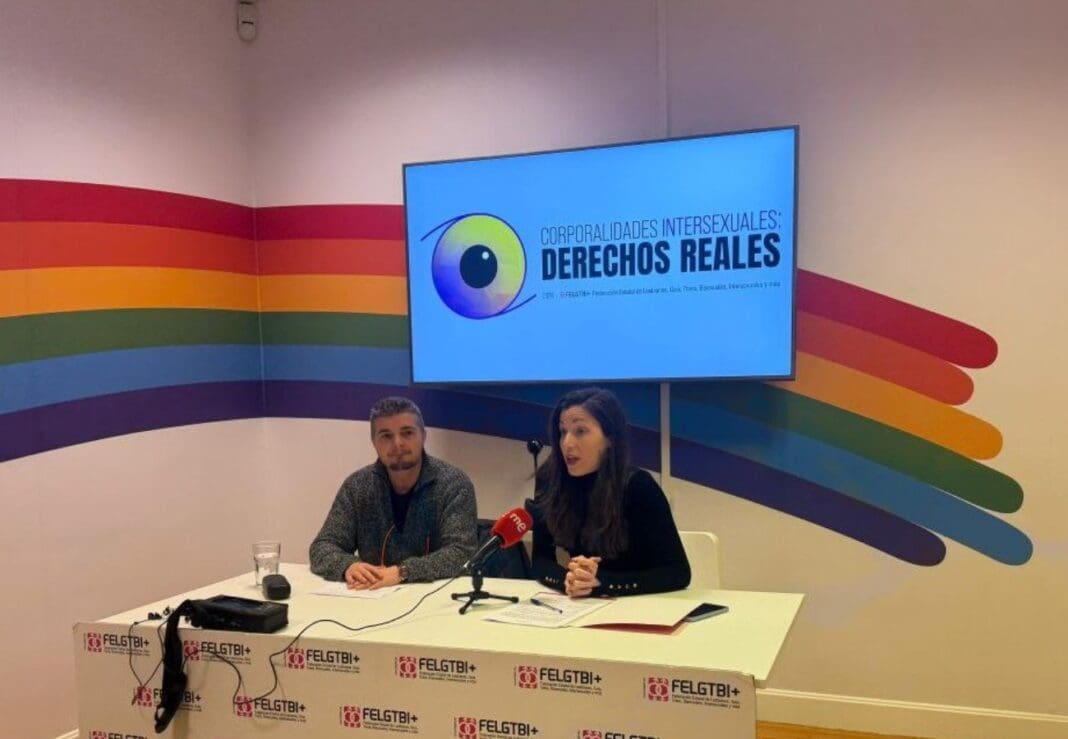
The LGTBI+ State Federation (FELGTBI+) has announced that its Thematic Year for 2026 will be dedicated to the vindication of the human rights of intersex people, under the motto “Corporalities Intersexuals: real rights.” A decision that seeks to break the silence and invisibility that have historically marked the lives of thousands of people with natural variations in their sexual characteristics.
In a press conference, Paula Iglesias, president of the largest LGTBIQ+ entity in Spain, was clear: invisibility is a form of violence. “Intersex people have been systematically excluded from medical, educational, legislative and social discourses,” Iglesias stated. Its objective for next year is forceful: to place the realities and demands of intersex people at the heart of the public, political and social debate in Spain.
Luc Vañó, representative of the Thematic Year Commission, emphasizes that this election is a “real urgency” to make visible and move towards a model that prioritizes diversity, bodily autonomy and, above all, human rights.
Silent Violence: Non-Consensual Surgeries
One of the main violations of rights faced by intersex is the performance of medical interventions and surgeries, often irreversible, carried out in childhood without the free, prior and fully informed consent of them or their guardians.
Although these practices are explicitly prohibited in Spain by the LGTBI+ State Law and contravene the Charter of Fundamental Rights of the European Union, Paula Iglesias warns that the lack of knowledge in the health community perpetuates these actions. Intersex realities continue to be addressed as a pathology, unnecessarily medicalizing a part of bodily diversity.
The Federation demands compliance with the Law, demanding that administrations guarantee sufficient, continuous and updated health training on human diversity and the specific needs of intersex people.

The Scars of Silence
Intersex people carry with them the traces of these decisions made about their bodies without their consent. Luc Vañó details the serious consequences:
- Unnecessary surgical interventions and genital mutilations.
- Hormonal treatments and forced medicalization.
These practices go beyond physical scars (chronic pain, loss of sensitivity or infertility). They have a profound impact on:
- Physical and mental health.
- Identity and self-esteem.
- The emotional life.
They are, in essence, violations of human rights. Furthermore, the impact extends to families, who often receive biased or alarmist information and are pressured by the medical field to “correct” non-ill bodies. To what extent do social pressure and lack of information push us to make decisions that affect the lives of others? It is a crucial moment for the reader to reflect on the right to bodily autonomy from birth.
A revealing fact from the FRA in the European Union exposes the seriousness of the situation: only four out of ten intersex people or their families received detailed information before the first medical treatment. Six out of ten, for their part, did not sign any informed consent.

Vañó also remembers that intersexuality is not always detected at birth, often manifesting or being diagnosed in adolescence or adulthood. Reducing the debate to childhood surgeries makes invisible thousands of people who also suffer stigmatization and late exclusion.
Roadmap 2026: For Real Rights
The FELGTBI+ has outlined its action plan for 2026 with a clear focus on structural and cultural change:
- Political and Legal Advocacy: Fight to eradicate non-consensual medical practices and achieve legal recognition of the existence of intersexualities.
- Participation: Promote a real presence of intersex people in all decision-making spaces.
- Partnerships: Promote collaboration with medical and human rights entities to end pathologization.
- Health Care: Demand respectful care protocols that guarantee bodily autonomy.
- Awareness and Culture:
- Raise citizen awareness about intersex experiences.
- Interpelate the media for respectful and rigorous representations.
- Promote a transformation of the educational field.
- Share a guide on intersexualities as a key information tool.
- Awareness and Culture: