
New forms of family, same desire to love
When we talk about family, we often think of the classic image: mother, father, children. However, that representation does not encompass the real diversity that already exists on our streets, schools, parks and homes. One of the most visible configurations—and also the most questioned—is that of homoparental families.
But what exactly are they? What challenges do they face? And why do we still need to talk about them in 2025?
Clear definition: what does “homoparentality” mean?
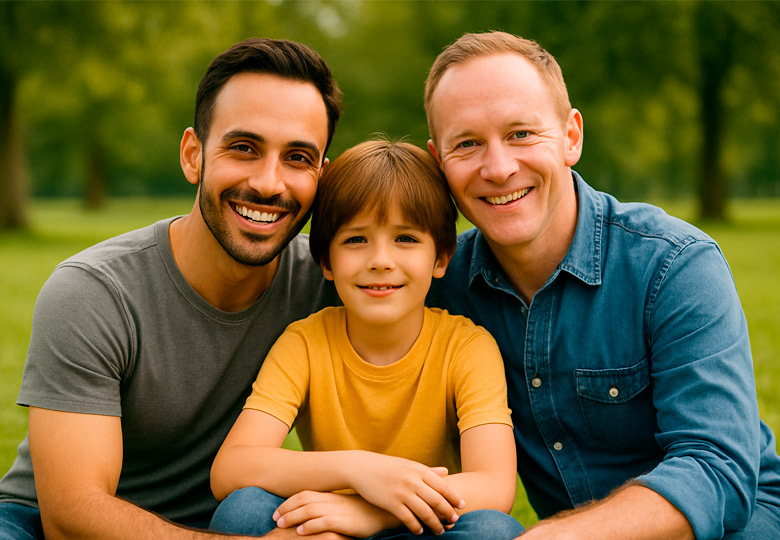
The term homoparental family refers to those family units in which children are raised by a same-sex couple. That is, two mothers or two fathers who assume parenthood jointly, whether through adoption, assisted reproduction, surrogacy or co-parenting models.
Although the term may seem technical, it actually refers to something very everyday: the desire to start a family, to care, educate and love on equal terms.
Types of homoparental families
Homoparenting can take different forms. Here are some examples:
- Two lesbian mothers who resort to assisted reproduction and raise their son together.
- Two gay parents who adopt or access surrogacy in countries where it is legal.
- Reconstituted families where one of the parents joins a new couple of the same sex and they raise together.
- Coparenting between LGTBIQ+ people, where there is no romantic partner, but there is a conscious shared parenting agreement.
As you see, there is no one way to be a family. And that’s the beautiful (and challenging) thing about this topic.
What is it like to grow up in a homoparental family?
The majority of studies carried out in the last 20 years agree: children from homoparental families do not present significant differences in their emotional, academic or social developmentwith respect to those who grow up in heteroparental families. What really influences is the climate of love, support and security that surrounds childhood, not the sexual orientation of those raising children.
In addition, many children who grow up in these homes develop strong empathy, critical thinking, and egalitarian values from an early age. They know that there are multiple ways of loving, of being, of inhabiting the world.
Legal and social challenges
Despite progress, homoparental families continue to face barriers. In Spain, for example, equal marriage has been legal since 2005, and with it, the possibility of joint adoption. However, there are still legal loopholes that make the full recognition of both parents difficult, especially in cases of assisted reproduction or non-biological motherhood.
And beyond the legal level, there is the social level. Uncomfortable looks in the pediatric consultation. School forms that only include “father” and “mother.” Ignorant comments on birthdays. The reality is that, although formal recognition exists, full standardization is still in process.
A question of rights, not ideology
Sometimes the existence of these families is presented as an “agenda” or a “social experiment.” But the truth is much simpler: it’s about rights. To protect minors. To guarantee that their families are respected and recognized.
Denying homoparenthood or making it invisible does not prevent it from existing. It only generates pain, legal uncertainty and exclusion. Therefore, naming it is a way to protect. Talking about it is opening paths.

What can society do?
You don’t have to be a jurist or activist to contribute to the visibility of these families. There are small, but important gestures that we can do:
- Use inclusive language in educational and work spaces.
- Correct those who misinform or spread prejudice.
- Support books, movies or content that shows this family diversity.
- Accompany with respect if you have a homoparental family nearby.
- Ask yourself: do my actions and words help or exclude?
Because yes, change also begins in everyday life. In how we look. In how we speak. In how we educate.
What if everything is not so clear?
Now, not everything is so linear. There are also tensions within the LGTBIQ+ movement regarding how families are built. There are those who question whether replicating the traditional model—even with two moms or two dads—perpetuates conservative or exclusive structures.
In addition, in cases such as surrogacy, complex ethical debates arise. Where is the body of the pregnant woman? What role does economic privilege play? Who decides what is family?
These questions do not have single answers. But ignoring them doesn’t help either. Thinking about them is part of the process of building a more just, diverse and conscious future.
Towards a society that embraces all forms of love
Deep down, talking about homoparental families is talking about love. Of commitment. Of real links. And also of structures that, although they are advancing, continue to need revision, courage and reforms.
Are we prepared as a society to stop talking about “different families” and simply talk about families? How much do we have left to unlearn so that the children of two moms or two dads don’t have to explain their lives at every class meeting?
We may not have all the answers, but we are clear about one thing: all families deserve respect, recognition and full rights. And that should not be negotiable.