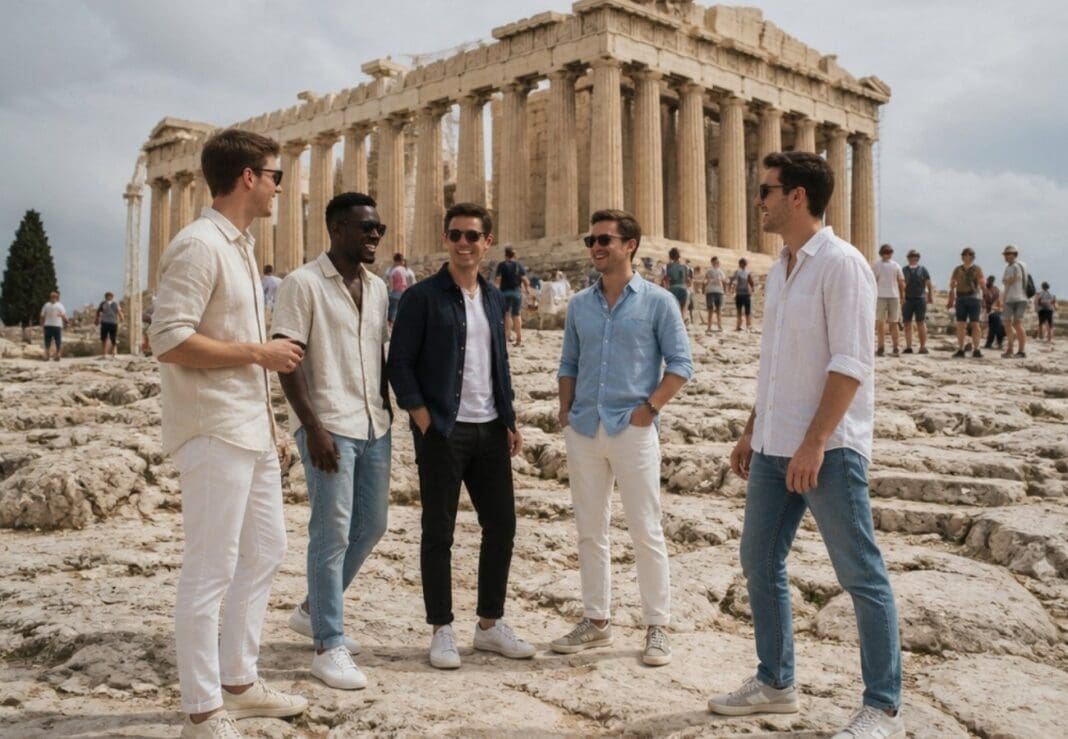

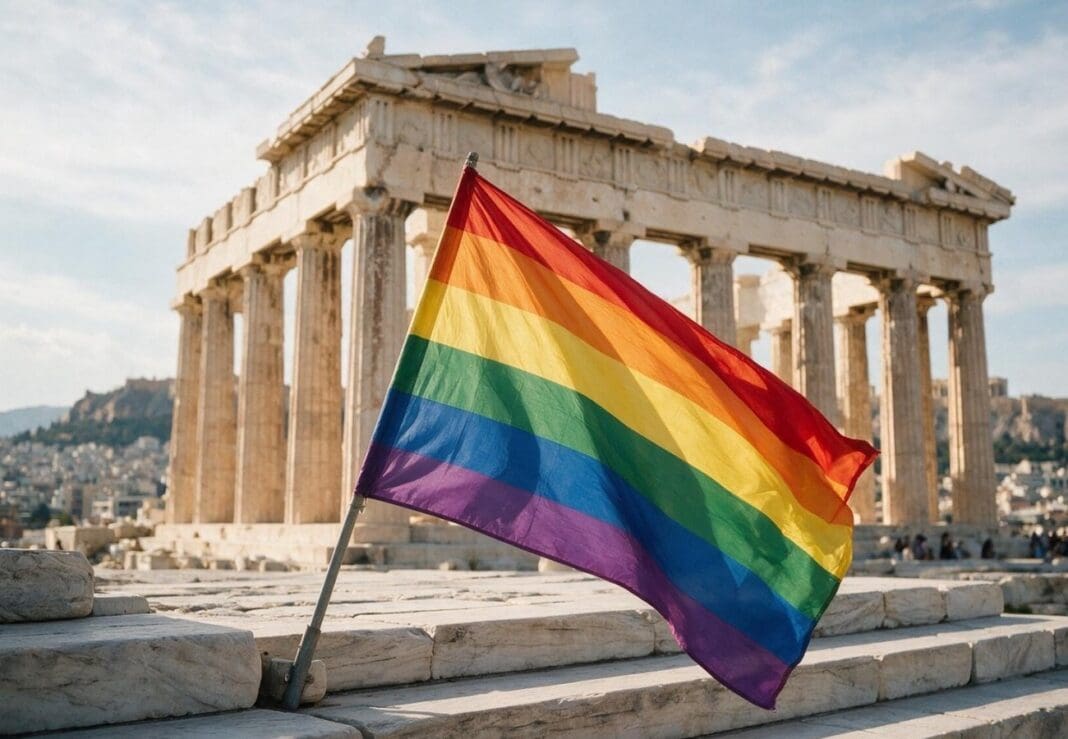

- From Gazochori, a working-class neighborhood next to a 19th-century gas factory, to the cultural and nightlife epicenter of Athens: Gazi has changed its skin several times in 170 years.
- Today it concentrates a good part of the LGTBIQ+ life of the city, with reference venues such as Noiz Club, Sodade2 or Shamone Bar, and views of the illuminated Acropolis from many terraces.
- It is also a stop on the trip Classical Greece of Apollo, with which Revista Rainbow collaborates — and with which you have a €50 discount with the code RAINBOW50.
There are neighborhoods that are understood by looking at a map, and neighborhoods that can only be understood by looking at their history. Gazi is one of the latter. Where electronic music plays until dawn, there was, for more than a century, a factory that illuminated Athens with gas. Revista Rainbow and Apollo invite you to discover Greece, and before telling you about the trip, we want to tell you why this neighborhood has become a destination in itself for any LGTBIQ+ person visiting the Greek capital.
Your Revista Rainbow discount
With Revista Rainbow, you have €50 discount on the price of the trip using the code
RAINBOW50 when booking at apoloeventstrips.com, or directly via WhatsApp at
+34 677 824 364.
From Gazochori to Gazi: the factory that gave its name to a neighborhood
Before being called Gazi, the area was known as Gazochori or Fotaerio, a working-class neighborhood that grew around the gas factory founded in 1857, which supplied lighting to Athens. For much of the 20th century, small homes with gardens housed working families — including artisans dedicated to making wooden boxes — while the factory set the rhythm of the neighborhood. In 1967, socioeconomic difficulties in northern Greece led several Muslim families to settle in the area, and over the years workshops, spare parts shops, and small industrial businesses proliferated.
The factory closed in the mid-80s. In July 1986, the Ministry of Culture declared the building a protected historical heritage site, and on September 30, 1987, it reopened its doors converted into Technopolis, a cultural center of about 30,000 square meters that today hosts everything from art exhibitions and music festivals to food and technology fairs — in addition to the Industrial Gas Museum and the only skywalk in the city.
A neighborhood that lights up at night
Since the early 2000s, Gazi experienced what the city guides describe as an “urban update”: restaurants, concert halls, galleries, and nightlife venues arrived, coexisting with the last industrial workshops. The neighborhood acquired its own identity, a mix of industrial past and cultural present — rusty rails next to trendy terraces — with the Benaki Museum opening a branch there and the Kerameikós metro station improving the connection with the rest of the city.
With that transformation also came the consolidation of Gazi as a reference LGTBIQ+ neighborhood in Athens. The scene is concentrated mainly on Konstantinoupoleos and Leokoriou streets, very close to the Kerameikós metro station (line 3), and combines gay-friendly bars, clubs, and venues with a peculiarity that few European cities offer: the illuminated Acropolis as a backdrop from many terraces.
Among the venues most mentioned by specialized LGTBIQ+ guides are Noiz Club, one of the most popular gay clubs in the city, with techno and pop sessions and an outdoor terrace; Sodade2, a true institution of the neighborhood; Shamone Bar, themed around Michael Jackson and known for its friendly atmosphere; and spaces like Bearcode Athens or S-Cape Bar, the latter also frequented by trans and lesbian audiences. This is complemented by a not insignificant argument for travelers: partying in Athens is, on average, much cheaper than in London or Paris.
A neighborhood that is also a memory of rights
Gazi does not live that LGTBIQ+ identity only in its nightlife. Every June, Athens celebrates its Pride, which gathers around 100,000 people, in a country that in 2024 took a historic step by legalizing same-sex marriage — a significant milestone in southern Europe. In this context, Gazi serves as a visible and everyday meeting point, not just as a stage for a night of partying.
Your Revista Rainbow discount
With Revista Rainbow, you have €50 discount on the price of the trip using the code
RAINBOW50 when booking at apoloeventstrips.com, or directly via WhatsApp at
+34 677 824 364.

Gazi, stop on the Classical Greece trip
This is precisely the neighborhood you will visit at night on the Classical Greece trip, the LGTBIQ+ proposal from Apolo Events & Trips with which Revista Rainbow collaborates. The outing through Gazi closes the day 3 of a five-day itinerary (October 8–12, 2026) that traverses Athens, Delphi, and the Argolid, and that specific day includes the Corinth Canal, the theater of Epidaurus, and the walls of Mycenae, followed by a Greek dinner with a folk show before heading to Gazi with the group.
The trip, in a small group of a maximum of 20 people, costs from €990 per person in shared double room (+€80 for the single supplement, subject to availability) and includes accommodation (4 nights at the Alassia Hotel), transfers, breakfasts, several meals, entrance to the main archaeological sites, and basic travel insurance. Flights, the tourist tax, and expenses in Gazi are excluded. The reservation starts with a deposit of €200 at apoloeventstrips.com, and the balance is due before September 15, 2026.