

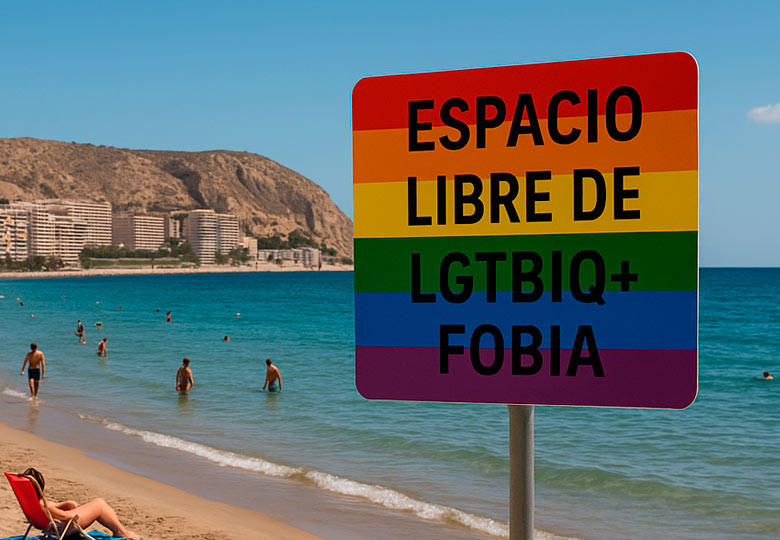

The Alicante City Council has initiated the procedures to adhere to the regional protocol that promotes safe environments free of discrimination towards the LGTBIQ+ collective.
The Alicante City Council has announced its intention to join the “LGTBIQ+phobia Free Space” protocol, promoted by the Generalitat Valenciana. The proposal, which will be debated at the next Local Government Board, seeks to make visible the institutional commitment to diversity, inclusion and respect for LGTBIQ+ people.
This protocol is framed within the State Equality Law for LGTBIQ+ people and its purpose is to identify spaces that promote security, coexistence and the explicit rejection of any form of discrimination based on sexual orientation, identity or gender expression.
What does this protocol entail?
Adherence to the protocol is not just a symbolic gesture. It entails a series of institutional commitments, both visible and internal. The City Council must actively disseminate the principles of the agreement, both among citizens and among its own staff, using in-person and digital media.
In addition, the council undertakes to act quickly and responsibly in the face of any act of LGTBIQ+phobia detected or reported in the municipal environment. This includes the implementation of awareness and training campaigns, the promotion of a culture based on respect and equality, and the strengthening of prevention and reporting mechanisms.
According to Begoña León, Councilor for Social Welfare, this accession represents one more step towards “public policies that promote equality and diversity, regardless of identity, gender expression or sexual orientation.”
These types of protocols are important. They make visible an institutional will and offer a framework for action that can serve as a guide to improve coexistence and prevent attacks. But you also have to ask yourself: is it enough to adhere to a protocol to guarantee truly safe spaces?
Numerous LGTBIQ+ organizations warn that many municipalities sign agreements without allocating specific resources for their implementation. Others do so without being accompanied by specific training plans or accessible channels for reporting attacks. Can a “LGTBIQ+phobia-free space” sticker on a façade change what happens inside institutions or on the street?
Publicly recognizing the value of diversity is key, especially in times when hate speech is gaining presence in some social and political sectors. However, the real challenge is in the day-to-day life: in how a trans person is cared for in a public service, in whether a same-sex couple feels safe walking through the city or in whether victims of LGTBIQ+phobic attacks find firm and effective support from institutions.
Alicante’s accession to the protocol is an opportunity. But only if it is accompanied by concrete measures, budgets, continuous training and, above all, active listening to the group. Because safe spaces are not created by decree. They build each other.