

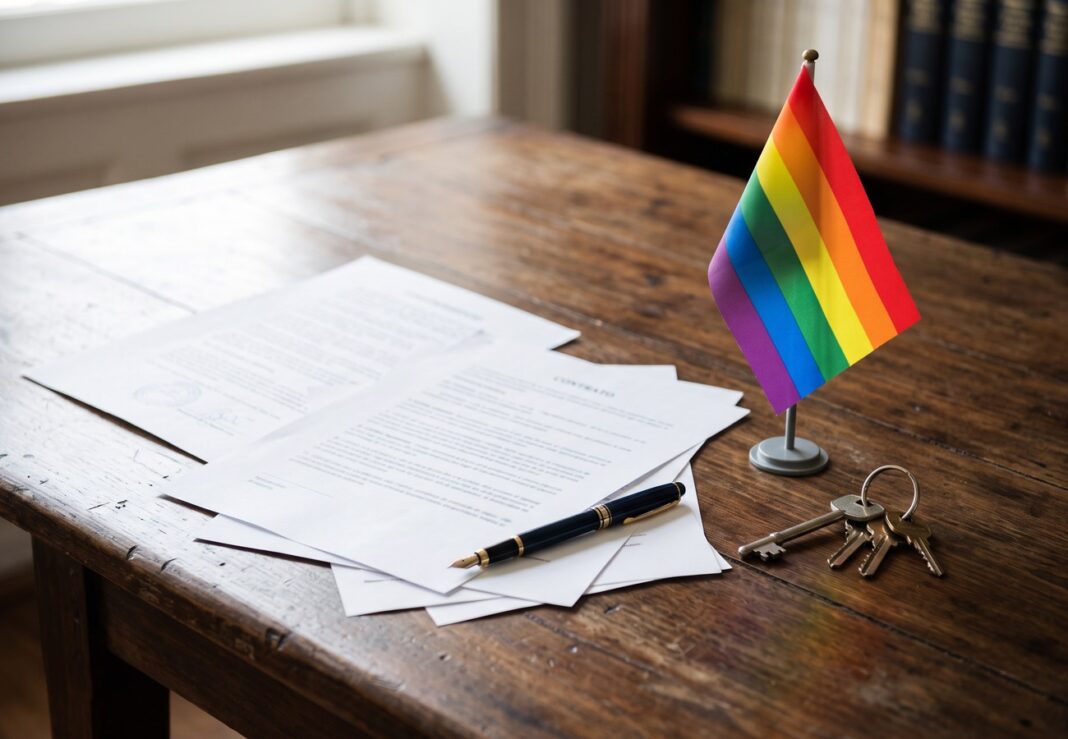

- The Provincial Court of Barcelona cancels the declaration that recognized a man as the stable partner of another man who has already passed away.
- For the court, there was no evidence of a “notorious, permanent and public” cohabitation of more than two years. Photos, trips, and keys are interpreted as a “deep friendship.”
- Since there is no stable partner, the inheritance goes to the deceased’s siblings, although a week before he died he had left his inheritance to his partner.
The Provincial Court of Barcelona refuses to recognize two men as stable partners and leaves the surviving partner without inheritance. According to the court, it was not proven that they were more than friends. The deceased’s assets, who had a terminal illness, go to his siblings. The text of the ruling was made known this Friday, November 13.
What has the Barcelona Court decided?
The Provincial Court of Barcelona has annulled the declaration that recognized the plaintiff as the stable partner of the deceased. It bases its decision on article 234-1 of the Civil Code of Catalonia, which regulates when a stable partner exists.
According to the Chamber, there is not enough evidence of a “notorious, permanent and public” cohabitation of more than two years. Without that requirement, Catalan law does not consider that two people form a stable couple, no matter how intense their relationship is.

A will signed a week before death
The deceased had a terminal illness and, a week before dying, signed a document of “last wishes.” In it, he designated his partner as the sole heir, ahead of his siblings.
Since the stable partner was not confirmed, the inheritance has gone to the siblings, because the deceased had no children, descendants, or living parents.
Why weren’t the photos, trips, and keys enough?
The court considered that the evidence demonstrated an emotional bond, but not a shared life project. The photos, trips, keys to the house, some occasional payments, and weekend stays were valued as signs of a “deep friendship.”
Witnesses and the hospital history did not help either, as they referred to the plaintiff as “friend.” Additionally, the court did not admit a document signed by a priest because its author did not go to ratify it.
The Chamber itself admits that, in human terms, that closeness “deserves recognition”. And does not rule out that there was a romantic relationship. But, for the law, that is not enough.
When is there a stable partner in Catalonia?
Article 234-1 of the Civil Code of Catalonia recognizes a stable partner in three cases: when cohabitation lasts more than two consecutive years, when the couple has a child in common during cohabitation, or when they formalize the relationship in public deed before a notary.
In this case, there were no children or deed, so everything depended on proving the two years of cohabitation. That is where the evidence failed.
How to protect your partner if you are not married?
The safest way to ensure your partner is not left unprotected is to put everything in writing and before a notary. This case teaches that if the relationship is not formalized, the other person has to prove cohabitation in court. And that is not always possible.
These are the steps to consider:


- Formalize the partnership. In Catalonia, through a public deed before a notary. In other communities, through their registry of de facto couples.
- Make a will before a notary and update it when your situation changes.
- Keep evidence of cohabitation: joint registration, rental or mortgage contracts, shared accounts or bills.
- Seek legal advice. Inheritance laws vary by autonomous community.
Many LGTBIQ+ couples, especially from older generations, have not made their relationship visible to their family, in the hospital, or at work. That is why this type of case affects them particularly.
You may be interested:
- The Supreme Court rules on the change of registered sex: protection and new criteria
- Feijóo promises to repeal the Trans Law for considering it “a frivolity”
Frequently asked questions
Why did the deceased’s partner not inherit?
Because the Barcelona Court did not recognize that they were stable partners. Since two years of cohabitation were not proven, the inheritance went to the siblings.
What requirements are there to be a stable partner in Catalonia?
Cohabit for more than two consecutive years, have a child in common during cohabitation, or formalize the relationship in a public deed.
What evidence did not convince the court?
The photos, trips, keys, some occasional payments, and weekend stays. Witnesses and the hospital history referred to “friend.”
How can I protect my partner?
By formalizing the relationship, making a will before a notary, and keeping evidence of cohabitation. Seek legal advice for your case.