

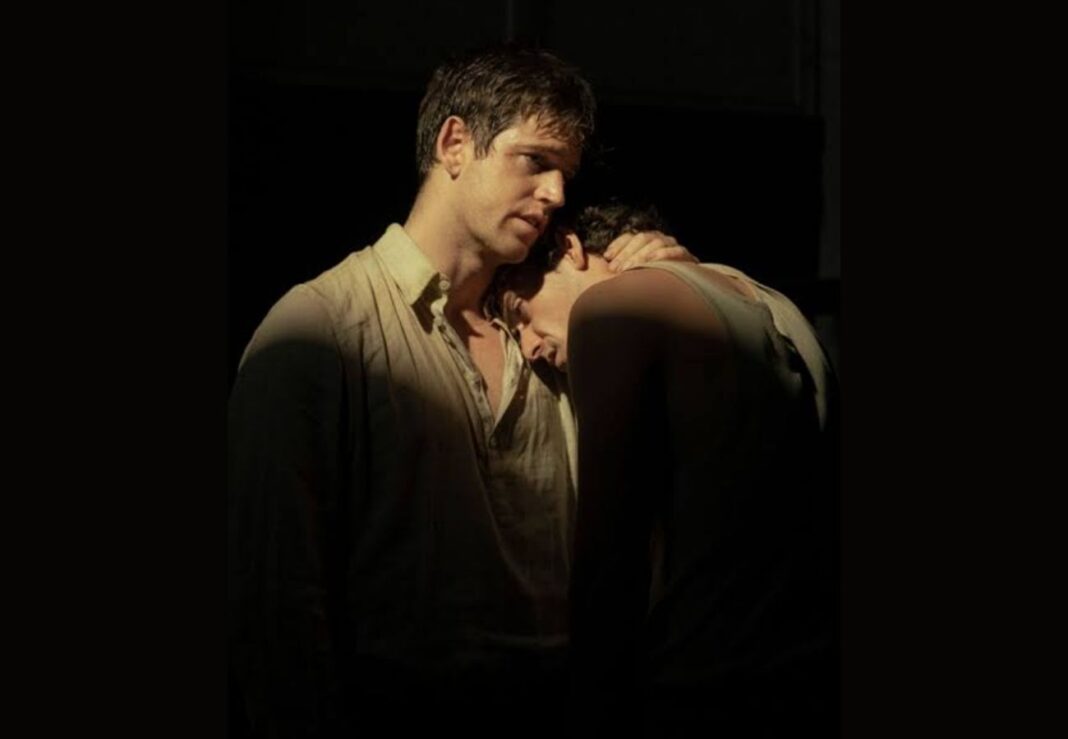

There is a moment that does not appear in the credits of any movie: when the show ends and an entire room remains silent. When someone cries. When we understand that what we have just seen does not stay on the screen.
That happened to me with The Black Ball.
And perhaps the first criticism that this film deserves is simple: it is a necessary film.

Necessary to think, to feel, and to remember.
The Javis turn the universe of Federico García Lorca into a production of enormous dimension, visually ambitious and deeply cared for. There is a staging that dazzles, a period reconstruction that transports, and a photography that turns every space into part of the story. But behind that spectacularity, the essential never disappears: the people and their stories.
And there appears Lorca. Not only the poet that we all learned to name, but the man, his desire, his silences, and the Spain in which he had to live. Approaching Lorca from this perspective allows us to discover another dimension of a fundamental figure of our culture and, at the same time, to look again at a part of Spanish history marked by censorship, persecution, and fear.
The film does it with a sensitivity that avoids turning memory into a museum piece.
And the performances sustain that journey. There are interpretations of enormous intensity, capable of conveying what is often left unsaid: a glance, a silence, a wait, the fear of being discovered. The emotion is not only in the great moments; it is also in those small gestures that make the characters seem like people before they are characters.
But The Black Ball does not only speak of the past.
It speaks of us.
Because the LGTBIQ+ rights that we can exercise today did not appear out of nowhere. Behind every conquest are people who had to hide, resist, lose connections, or wait for decades to be able to live with greater freedom.
Rights have memory.

And that memory also leads us to an uncomfortable question: what happens to those who today reach old age after having lived a good part of their lives having to hide?
LGTBIQ+ old age remains a pending conversation. What does it mean to need care after having learned for decades to protect our identity? Can we talk about our partner? Do we keep our networks, our stories, our chosen families?
The Black Ball looks back, but manages to make us think forward.
Perhaps that is why an entire room ends up crying.
We cry for Lorca. For those who were before. For those who could not live as they wanted. For those who fought so that others could do so.
But also because we know that there are still stories that need to be told.
I left the cinema thinking that perhaps that is one of the most powerful functions of cinema: to make a story from the past become a question about our present.
And when an entire room cries, perhaps it is not only because a movie has moved us.
Perhaps it is because, for a couple of hours, **we all understood something we needed to remember. I hope this type of stories continues to be told. I hope the film wins more awards than it has been winning. **